Tag Archives: Musical Theater

Catastrophe Party

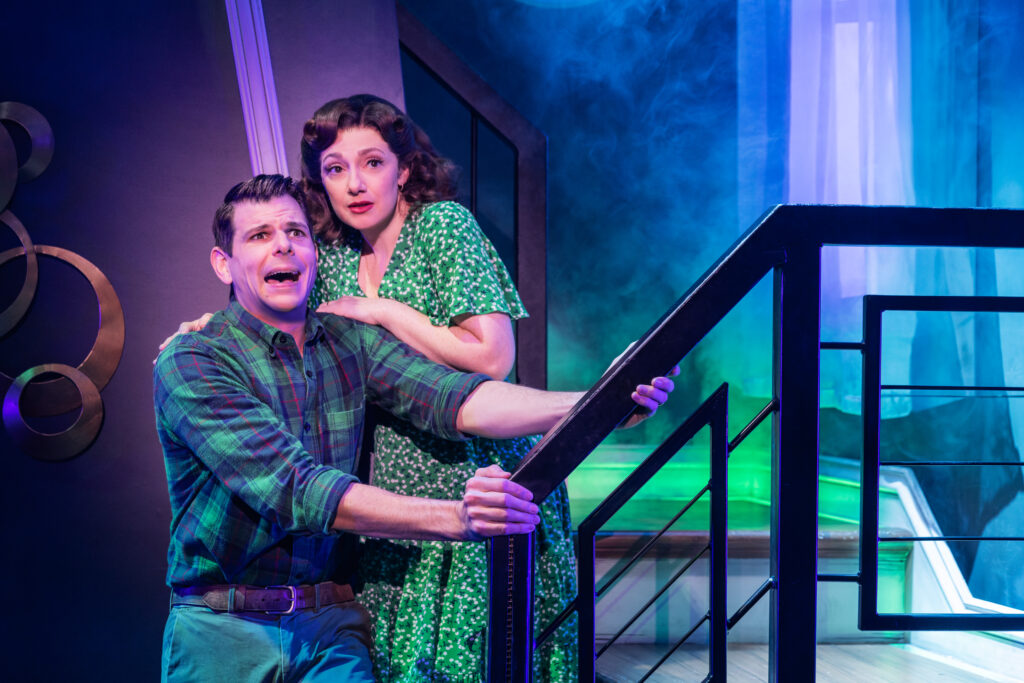
Photo by Mark Frohna

by Jeff Grygny

It’s an indisputable fact that people don’t usually sing and dance in public. It’s just as true, though less obvious, that there can be times in our lives that are so intense and emotional, they take on the heightened character of art. Often these moments aren’t fun to live through (ain’t it so?).  Such times can’t be theatrically expressed within the boundaries of realism: they call for—a musical! Come From Away, the show currently playing at Milwaukee Rep, takes events that really happened to real people and renders them into a rousing, roof-raising, foot-stomping testament to the power of human connection. It’s little wonder that the Broadway production was nominated for seven Tony awards. As the opening show of the Rep’s brand new upgraded theater center and the Ellen & Joe Checota Powerhouse, Come From Away is a masterful display of theatrical craft: an auspicious inauguration for Milwaukee’s newest stage.

In 2001. when terrorists crashed passenger planes into the World Trade Center and Pentagon, the government closed all US air space, effectively stranding thousands of people who happened to be in traveling at the time. Come From Away tells the story of some seven thousand passengers whose planes were re-routed to the small town of Gander, Newfoundland, which adjoins what was once the largest airfield in the world: a mostly-abandoned former World War II site. The locals, faced with the sudden doubling of their population, scrambled over four days to feed, clothe, and house their unexpected drop-ins.

Photo by Mark Frohna

The Canadian co-writers, wife and husband team Irene Sankoff and David Hein (also creators of the somewhat less-famous 2009 show My Mother’s Lesbian Jewish Wiccan Wedding), masterfully cull a handful of characters out of the thousands with a canny eye for relatable drama and song potential: the doughty town of down-to-earth islanders (with chowder-t’ick Canuck accents); the gay couple (both named Kevin); the mother whose firefighter son was stationed near the World Trade Center; the Muslim passenger treated with hostility and suspicion; the animal shelter manager who took it on herself to care for all the stranded pets; the pilot who was the airline’s first woman captain. Their stories weave together sympathy, humor, tragedy, and inspiration like the movements of a symphony: a remarkable feat, especially since it’s fundamentally about being stuck in a place where you don’t want to be.

Director Mark Clements heaps on the theatrical pizzazz, keeping the stage in constant dynamic motion while shepherding his twelve performers into three times as many characters: passengers waiting on a grounded plane, on a bus in the middle of the night to an unknown destination, changing into donated clothes, and sleeping on the floor in various shelters. The experience of refugees—of losing your sense of self as your normal life suddenly drops away—is vivid and poignant. On opening night, with an audience of donors and dignitaries, the performers were clearly giving it their all. It might be more fun to play a villain, but this ensemble embraces their roles as heroes from the first musical bar.

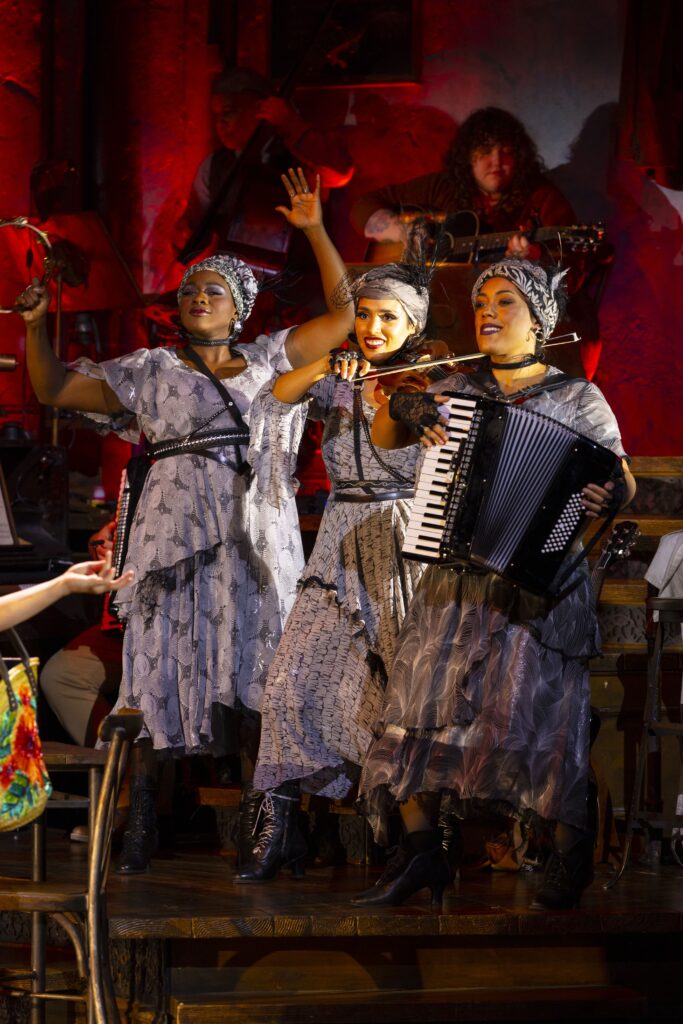
Jenn Rose’s choreography eschews virtuosity to portray ordinary bodies: nothing fancy, just the energetic clapping, fist-pumping, stomping moves of tough, determined people. Music Director Dan Kasemi has assembled a band of crack musicians who play instruments associated with the Brit-Irish-French traditions of Newfoundland, including accordion, fiddle, whistle, mandolin, and frame drum. Todd Edward Ivins’ single set incorporates weird rock formations that conjure a desolate island, with hazy projections by Mike Tutaj that evoke the vast oceanic skies. Wisely, they choose not to exploit the tragic images of the burning towers that figure so centrally in the story: we are left to recall them ourselves while characters stare at news broadcasts.

Photo by Mark Frohna

As the Gander folk work around the clock to provide for the “plane people”, we see everyone making new friends, taking comfort in prayer, phone calls, corny jokes, and liquor. Inevitably tensions mount, so the townspeople hold a boozy blow-off-steam party, with live music (including incredible fiddling by Wisconsin-raised Glenn Asch), karaoke (yes, they belt “My Heart Will Go On”), and a silly “Become a Newfoundlander” ceremony. It works, and a little temporary culture has formed, with bonds that last long after the planes have taken flight.

People who have lived in extreme conditions like wars or natural disasters often report an extraordinary feeling of camaraderie like nothing ordinary life offers. We never court catastrophe, but it can bring out the best impulses of human nature along with the worst. Now here’s the thing about theater: we can find something like that feeling by sharing stories of perils and survival. After all, it’s why so many cultures perform rituals: singing and dancing in public. The live experience is what makes the magic work; computers or cellphones just aren’t the same.

Great art is not just about challenging our preconceptions or exposing unpleasant truths, it’s also—maybe even more— about reminding us of simple, basic things that are easy to forget. In dark times like ours, we most desperately need to remember that we’re all in this together. Wouldn’t it be great if we took our current crisis as an opportunity to reach out? So go ahead: get soused with someone different from you. Belt out “My Heart Will Go On” together and see what happens. Or—you could bring them to see Come From Away.

Milwaukee Rep

presents

Come From Away

Books, Music and Lyrics by Irene Sankoff and David Hein

Directed by Mark Clements

November 4 –December 14, 2025

Running time: 90 minutes with no intermission

To purchase tickets, go to www.MilwaukeeRep.com, call the Ticket Office at 414-224-9490, or visit in-person at 108 E Wells Street in downtown Milwaukee.

WANT TO GET UPDATES EVERY TIME A NEW REVIEW IS POSTED?
Just send an email to:

playonmke@gmail.com

with the heading SUBSCRIBE ME

And you will be added to our contact list. Your contact information will be used for no other purpose than to give you reportage and analysis of the most cutting-edge, challenging, and inventive theater in Milwaukee!
The Imp of the Perverse

We stand upon the brink of a precipice. We peer into the abyss—we grow sick and dizzy. Our first impulse is to shrink away from the danger. Unaccountably we remain… (Edgar Allan Poe “The Imp of the Perverse”)

photo by Matthew Murphy, 2022

by Jeff Grygny

In 1988, a young director named Tim Burton made a fabulously inventive movie that flipped the haunted house story inside out: it was about two hapless ghosts trying to exorcise the awful people who moved into their beloved home. Quirky and weird-cute, with a no-brakes calliope score by Danny Elfman, it was well-received by critics and public alike. Now, 30 years later, so their own mysterious reasons, desperate producers have decided to bank on the film’s warm memories, and so we have a both big-screen sequel (unimaginatively titled Beetlejuice Beetlejuice), and a stage musical adaptation. The latter, winning good reviews on Broadway, has arrived in Milwaukee in a touring version, with high-tech polish and a talented cast of professional singer/dancer/actors eager to show the hinterlands what exactly it was that made Lauren Boebert so hot and bothered that she effectively crashed her career as a right-wing attack troll. So now the question before us isn’t really “Is it good?” but rather “Why? What is it actually for?”

photo by Matthew Murphy, 2022

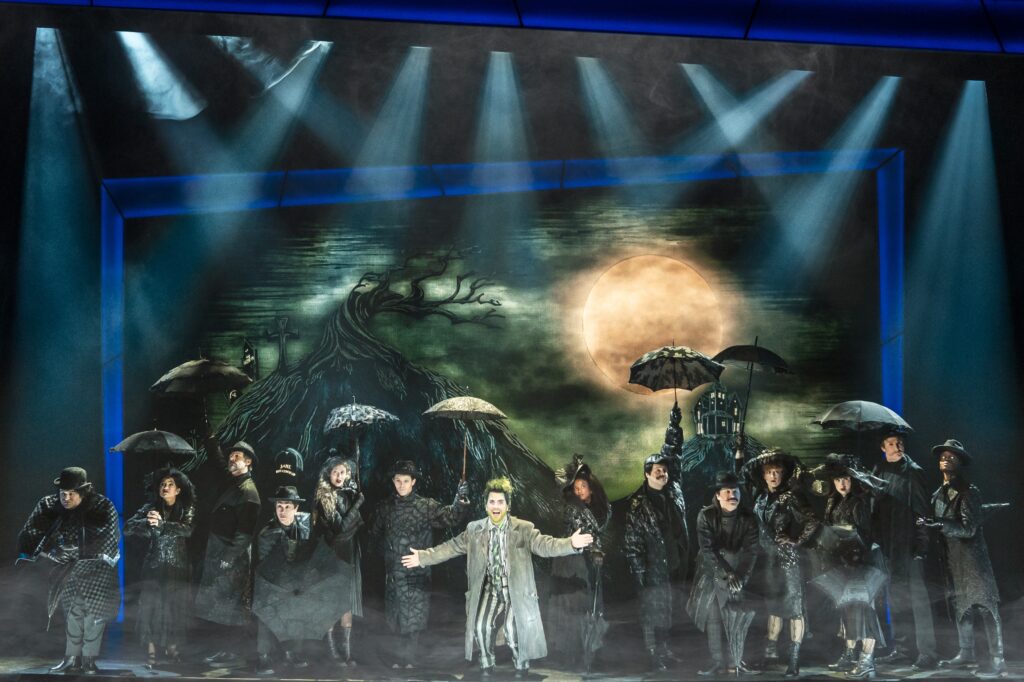
Once you get over the show’s inevitable reek of corporate spreadsheets, it’s pretty darn fun: a prime specimen of Industrial Entertainment Product™, with all the glitz and dazzle, design and music that call back to the movie, and a bushel of witty, hard-to-follow songs that all end with a big, applause-demanding finish. In the role of the eponymous antihero, Justin Collette dominates the stage, with the comic voice and quick attitude changes of a cadaverous Robin Williams. “I say this bullshit like eight times a week,” he quips early in the show: a Deadpool-like smirk to the audience characteristic of much of today’s Industrial Entertainment Product™.

photo by Matthew Murphy, 2022

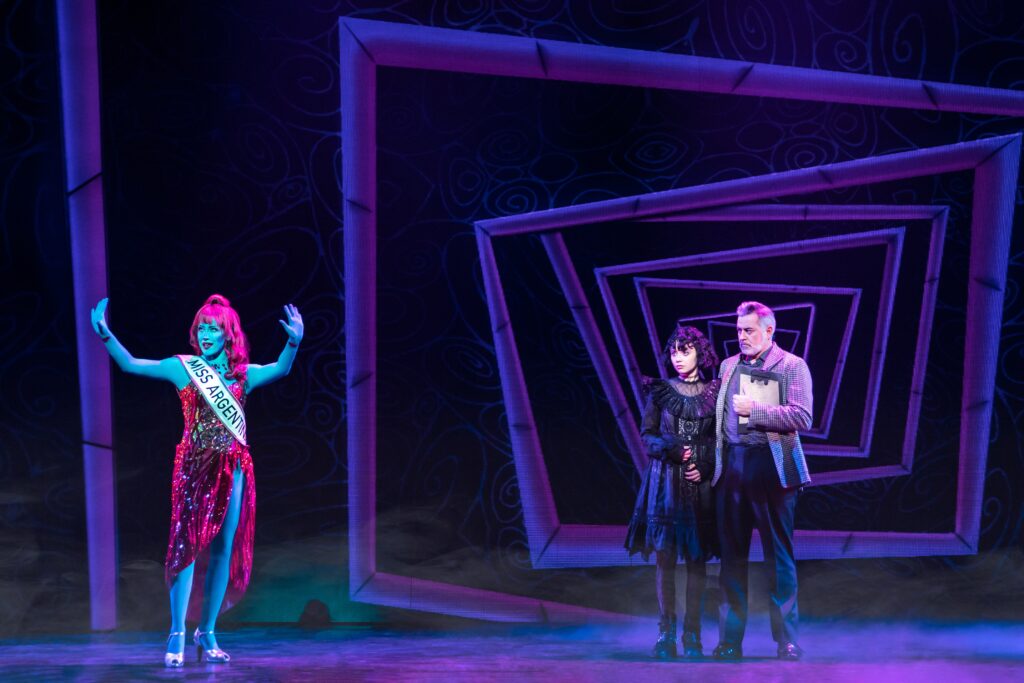
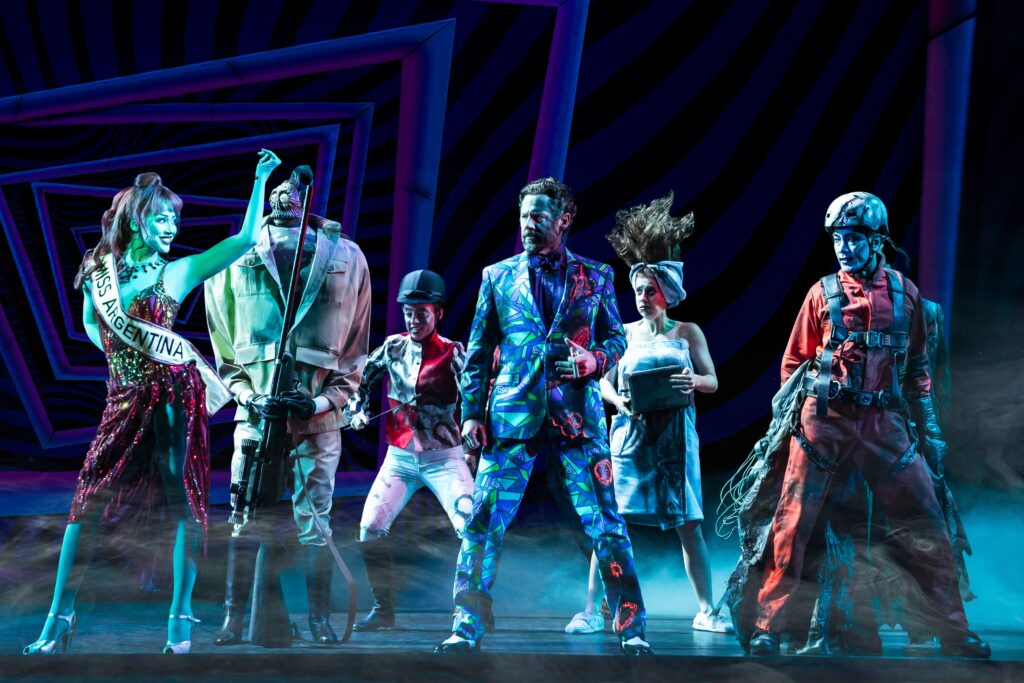
There’s not a bad performance, and some of them really shine: Will Burton, as the erstwhile yuppie ghost, brings a gangly, goofy “Brad” energy that nearly steals the show. Nevada Riley, as the goth girl™ Lydia, struggles a bit making the heavy-load-bearing lyrics understandable, but she does a lot of the show’s emotional labor, with angsty ballads and soaring aspirational solos. In a dramatis personae of basically horrible people, Sarah Litsinger is surprisingly sympathetic as the new age bimbo Lydia’s father hires to break her out of her shell of gloom, while, in her supporting roles, Maria Sylvia Norris memorably turns her cartoonish intensity up to 11. And, like the Lady of the Lake in Spamalot, Hillary Porter as Miss Argentina, makes the most of her completely gratuitous number.

photo by Matthew Murphy, 2022

The set and puppet designs by David Korins and Michael Curry are stylishly macabre: shrunken-head guy makes a cameo appearance in a dance number, there’s a fun skeleton chorus, a monster soul-eating snake, and an amusing chase through the Netherworld. Connor Gallegher’s choreography is bog-standard, but diverting and well-executed. Peter Nigrini’s projection designs are classy, effective, and don’t look like they were made by AI: a strong plus. And the eight-piece band was effortlessly kicking it. So the show is fine escapist fun. But is it about anything besides it’s balance sheet? Why Beetlejuice? Let’s take a deep dive, shall we?

The name “Beetlejuice” is a clever take-off on the name of an actual celestial star: Betelgeuse, from the Arabic name “Hand of Orion,” (it’s in that constellation). It got its first letter “B” from a medieval copying error, (without which we’d have had to call the show “Veetlejuice,” which is not nearly as catchy)! And from ancient times it’s been known for it’s fluctuating brightness (it virtually vanished from the sky a few years ago, but it’s mostly back—for now.) So, randomness and chaos are baked right into the name. “Beetlejuice is also just a marvelous name for a demon; it’s a fusion of ugly sounds and images, like the devils’ names in C.S. Lewis’ famous Screwtape Letters, and it calls back to the biblical demon Beelzebub—itself an insulting term for the ancient pagan deity Baal. None of this seems especially relevant—or does it?

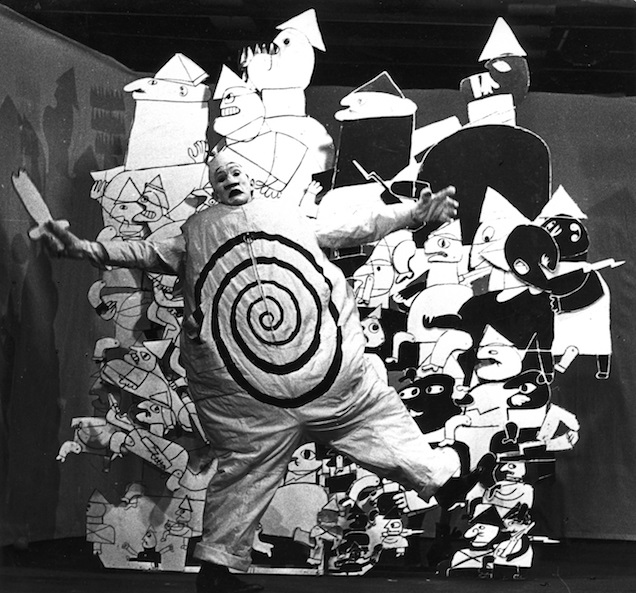
photograph from Michael Meschke’s production of Alfred Jarry’s Ubu Roi, 1964

The character of Beetlejuice is a variation of a very old mythological trope: the Trickster. Usually troublesome and rather stupid, self-centered, unscrupulous, and almost always male, the Trickster makes trouble for ordinary folks. With his coarse appetites, foul mouth, and even his black-and-white outfit, Beetlejuice is arguably an update of Pere Ubu, a Trickster who appeared in the very first avant-garde play: Ubu the King by Alfred Jarry, an absurdist takeoff of Shakespeare’s plays. Pere Ubu is a gross, insatiable creature with an enormous belly who becomes king by violence and lies, and proceeds to ruin the land until he’s finally overthrown and exiled. Now, can anyone here relate to the problem of a disgusting chaos goblin who invades our lives and refuses to go away? I admit this this is taking the long way around. But even corporate art can sometimes echo the dreams and nightmares of our culture. And I’m not saying that the resurgence of Beetlejuice is playing out the unbearable tension of a criminal rising to political prominence. I’m not saying it isn’t, either. Ultimately, the show exists because some talented artists were moved to create it.

Scott Brown and Anthony King, who co-wrote the show, had previously written a somewhat successful show called Gutenberg! The Musical, about two guys who are trying to sell their idea for a musical about, you know, the book guy, playing the roles themselves. Eddie Perfect, who wrote the songs, is a performer who’s written a lot of political and cultural satire in his native Australia. These are very successful artists who are steeped in both the art and the business of musicals. Now, just suppose that there’s something about Beetlejuice that strikes a cord in this MAGA moment of American culture. It could be a big hit—but to get the investors to write checks, it would have to appeal to both sides. An antihero who’s gross and abrasive, but also funny and winks at the audience, wouldn’t alienate anyone, would it? The inappropriate humor, the cynicism, the unruly masculinity (which the dialog consistently lampshades, by the way): all of a piece with our cultural moment. The show both lampoons and celebrates the whole toxic mess, and wraps it up in a nice family reconciliation.

Either that, or it’s just a fun show that capitalizes on the richness and creativity of a marketable intellectual property. Step right up, folks!

Beetlejuice

Music and Lyrics by Eddie Perfect

Book by Scott Brown and Anthony King

Based on the Geffen Company Picture

Playing through October 6

Uihlein Hall

Marcus Performing Arts Center

American Gods

photo by T. Charles Erickson

It’s an old song

It’s a sad song

We sing it anyway

            Hermes, Hadestown

by Jeff Grygny

There’s no three-headed dog, no ferryman on the Styx. But make no mistake, Hadestown is the real thing: its creator, the supernaturally gifted Anaïs Mitchell, has obviously lived, dreamed, and traveled in the myths of Orpheus and Persephone, and she’s distilled their essence into a fable that speaks to parts of us that we might not have even known we have. It’s no wonder this raucous, rowdy, and deeply moving show won eight Tony awards and played on Broadway for over a thousand performances. Now it’s come here, in a touring production currently playing at the Marcus Center for the Performing Arts.

Mitchell sets her cosmic opera in a fairy-tale America, somewhere in the South, perhaps New Orleans. It’s a mythic, honky-tonk landscape reminiscent of Max Fleischer cartoons or Cohen Brothers movies. It doesn’t sound like highly processed Broadway Entertainment Product; it’s musical vocabulary is old-timey, with  jazz, folk, and Cajun flavors. You wouldn’t be surprised to see Tom Waits slouching in the corner. The remarkable orchestration by Michael Chorney and Todd Sickafoose deploys strange combinations of fiddle, cello, accordion, glockenspiel, and double bass, ably led by Eric Kang on stand-up piano, to create uncanny harmonies and haunting dissonances that echo a universe in constant precarity and go straight to our hearts, like the magical chords of Renaissance magic.

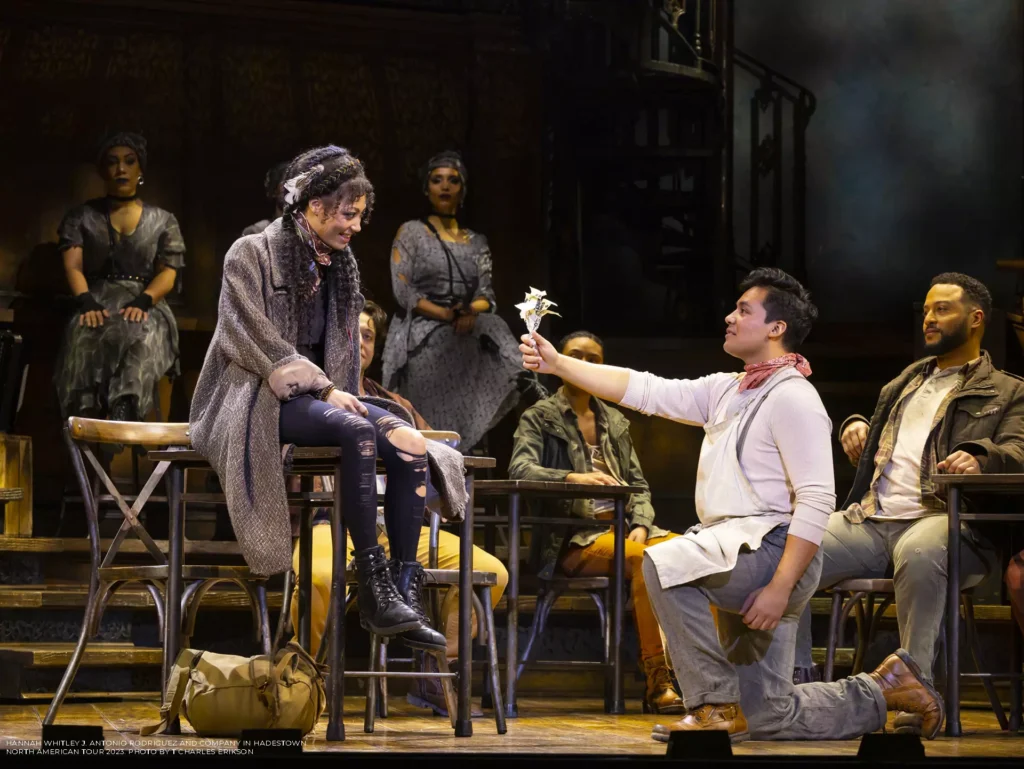
And like the first true opera, Monteverdi’s L’Orfeo, the show is entirely sung. It tells its story through feelings—and those feelings are mighty. There’s no back story for Orpheus and Eurydice, and no need for any. He’s a struggling singer/songwriter with a vision of restoring the world through art; she’s a young woman down on her luck who catches his eye. The capable touring cast performs with professionalism and flashes of brilliance. Hannah Whitley communicates Eurydice’s hardscrabble biography with her body language.  J. Antonio Rodriguez, with a falsetto like struck crystal, makes us believe that Orpheus can charm love even into the king of death.

Maria-Christina Oliveras brings abundant sass to her role as party girl/nature goddess Persephone (she’s the one they sing about when they sing “she’s comin’ around the mountain”). Nathan Lee Graham plays Hermes, the prince of magicians and salesman, with great panache, and, playing Hades, Matthew Patrick Quinn’s intimidating basso voice rumbles itself right into your chest. As the Fates, feared by both men and gods, Dominique Kempf, Belén Moyano, and Nyla Watson play their own instruments, making a sinister chorus of the sisters who know everything and smile as you go to your doom.

photo by T. Charles Erickson

The production glitters with all the technical arts of Broadway, including a revolving stage that’s very effectively incorporated into the choreography. The rock-concert lighting, underscoring every dramatic beat and mood shift, seems designed to make sure that even the drowsiest patron stays awake.

In this 19th century myth, the underworld is a factory town. While Persephone is up in the land of sunlight, the brooding Hades mines coal and forges steel; he builds engines and generators, and surrounds his realm with a great wall, convincing his slaves that it’s for their own security. Persephone is less than impressed: “it ‘aint natural.” she sings. When Orpheus arrives to help Eurydice break her desperate contract, he becomes something of a union organizer for the dead souls condemned to endlessly stoking Hades’ furnaces. It’s a powerful metaphor for the degrading effects of industrial capitalism, both on the natural world and on the human heart.

Orpheus’s songs awaken the spirit of love—but in the end he can’t defeat the Fates. Unlike Monteverdi, Mitchell leaves the tragic ending of the original myth intact. But she’s kind enough to let us down gently, and, after the curtain call, the players sing a final song as they raise their wineglasses in a salute to the eternal artist, seeing a vision of a world of love, and brought low by the cruelty of The Way Things Are, only to try again and again. Who knows—maybe next time will be different.

Broadway Across America presents

Hadestown

Music, lyrics and book by Anaïs Mitchell

playing through May 7