Tag Archives: Mark Clements

Critical Error

photo by Michael Brosilow

by Jeff Grygny

Artificial intelligence. Once a sci-fi term of unbounded possibilities, it’s turned out surprisingly apt in actuality: like artificial flavor or artificial flowers, it can do the job cheaply, but it just lacks something, that je ne sais quoi of the real thing. Could we call it “soul”?

Pulitzer prize-winning playwright Ayad Akhtar says he never fed his play McNeal through a chatbot, but he did explore AI while working on the script, which is now playing in a heart-pulsing, no holds barred production at Milwaukee Rep. As the maiden voyage of the high-tech Herro-Franke Studio Theater, it’s instantly made this new space the most exciting theater venue in town.

We first see the title character dressed in a medical gown, while his doctor tells him he will die in three months if he doesn’t stop drinking. Just then, he gets an international call, and suddenly he’s in a tux, delivering his acceptance speech for the Nobel Prize in literature. As performed with incredible stamina and masses of DGAF by Peter Bradbury, he’s a pompous know-it-all novelist in the mold of Norman Mailer or Philip Roth. In a gratingly loud voice, he delivers every utterance as if from on high, yet with enough humor and bravado to bend toward charisma. Unsurprisingly his personal life is a mess. He seems to have no friends, his wife committed suicide, and his son hates him, as does a former fling, whose extramarital affair provided the content of one of his best-sellers. “So I put real life into fiction,” he tells her, “that’s called art.”
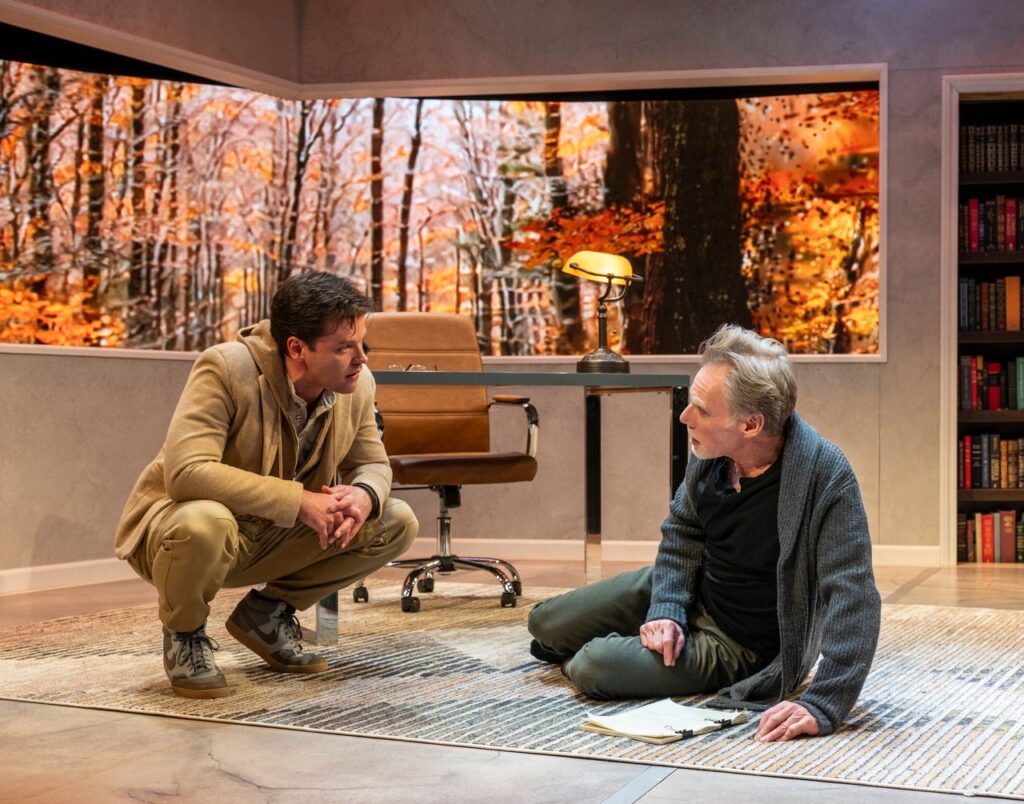
photo by Michael Brosilow

He pontificates that surprise is the key to great art, and this play is full of unexpected turns and odd off-moments (as are the plays of Shakespeare, whom Akhtar cites as a major inspiration). Its setting in the literary world means that the characters are all hyper-articulate—which is a joy in itself to hear. Jeanne Paulsen, as McNeal’s agent, in her Manhattan black outfit and rockstar boots, is like his Lady Macbeth, scheming to win the New York Times profile and best-seller list on release of his latest novel, and later hushing up the fact that he used AI to create it. N’Jameh Camara does a star turn as the literary journalist assigned to interview him. He offends her from the start, asking if she’s a “diversity hire,” and bragging about his friendship with Harvey Weinstein. But she’s a cool fighter herself; their verbal thrust and parry is as thrilling to watch as a fencing match. She concludes the interview with the brutal “I’m glad that the world is getting rid of people like you and making room for people like me.”

photo by Michael Brosilow

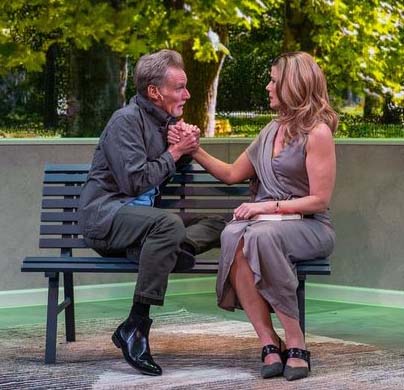
All the performers are at the top of their game. As McNeal’s haunted, resentful son, Ty Fanning embodies Orestes, Oedipus, and Konstantin from The Sea Gull (among others) in their harrowing, violent confrontation. As “the younger woman,” with whom McNeal cheated on his wife, Bridget Ann White delivers both compassion and  intelligence. In a scene that recalls Shakespeare’s most brilliant exchanges between the sexes, we can see her “doing the emotional work” on the fly, voicing, perhaps, what many women in her situation would wish they could say so precisely. Mark Clements’ sure-handed direction keeps the stage in dynamic movement, employing unconventional body language to vary the visual composition.
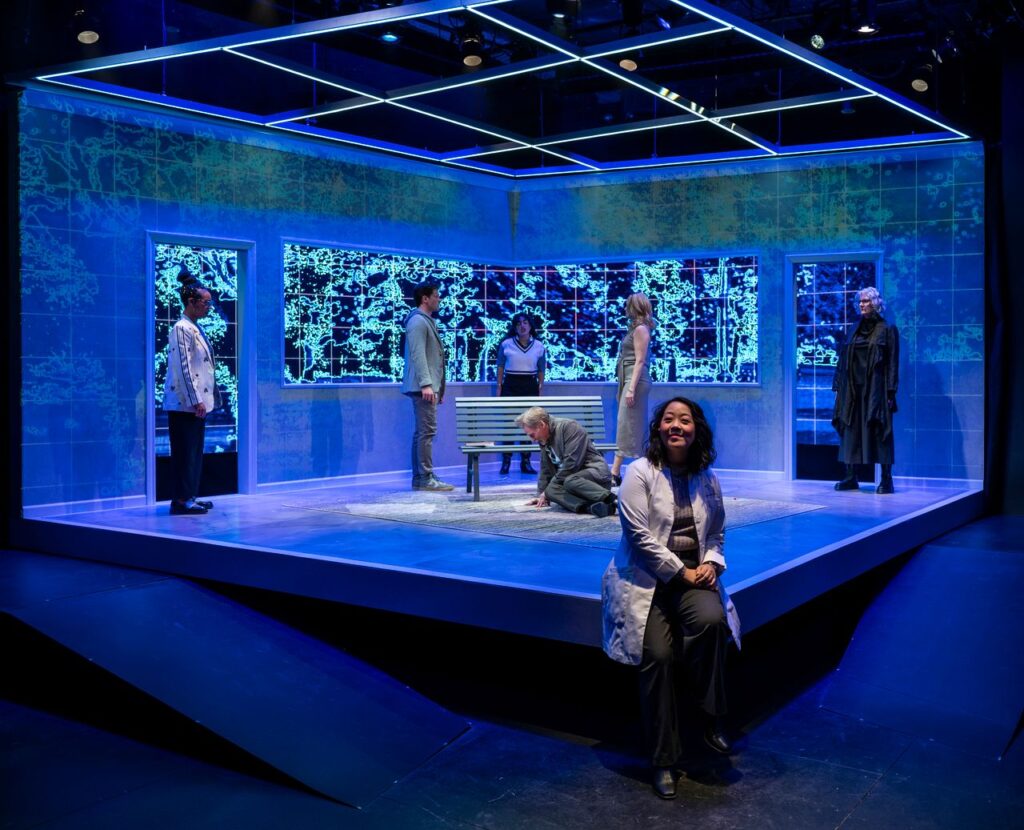
photo by Michael Brosilow

On of Aristotle’s six essential elements of tragedy is “spectacle,” and here the production overdelivers. The technical capacities of the Herro-Franke Studio Theater offer the design team a versatile, sophisticated instrument, which they play like Jimmy Hendrix on electric guitar. A motorized stage rotates Scenic Designer Emily Lotz’s brutalist set, teasing wall-sized projections of psychedelic graphics and digitally distorted scenery by Timothy Kelly that reinforce the show’s technological theme. Jason Fassl’s sensitive lighting and Dan Kazemi’s tone-perfect music subtly accent vibe shifts, and there’s a mind-bending tour-de-force pharmaceutical-induced hallucination sequence that recalls the scene in Richard III where the monarch is haunted by the ghosts of the people he’s wronged. It’s the dictionary definition of sublime, both grotesque and beautiful.

Ostensibly McNeal is about a famous writer who succumbs to the siren call of ChatGPT. But there’s a lot more going on in this Swiss watch of a play. Ideas and themes course through the performance, clashing like bucks butting horns. Akhtar doesn’t tell us what to think, but he raises so many questions, the play of thoughts in your head become another drama unfolding along with the one on stage. And the text evokes so much theater history, you can feel Shakespeare, Ibsen, Chekhov, Durrenmatt, even George Bernard Shaw, restively roaming behind the scenes. And then, midway through the play, we see a chatbot prompted to combine the works of as many famous writers and philosphers, along with other materials, into a novel “in the style of James McNeal,” and you begin to suspect that Akhtar generated it in AI himself (he says he didn’t— except for one crucial speech). Among the questions he raises are, in no particular order:

  • Why does he choose a “great white man” type for his protagonist?
  • Is McNeal a tragic figure? If so, what is his tragic flaw: the error that ultimately dooms him?
  • What are those giant projected deepfakes of Ronald Reagan and…Barry Goldwater, I guess?… about? Hallucination? AI hallucination?
  • When a voice came over the speakers saying “We are experiencing a technical difficulty, please remain in your seats” was that part of the play? It might have been!
  • Why break the narrative by showing text of the dramatic structure of the final few acts, only to depart from  it?
  • What’s up with the final speech, a response to a very specific prompt? It’s the only part of the play that Akhtar said he made with the help of AI—and even then he only used two lines of it. And it’s perfect, bringing an unexpected up beat to an otherwise grim tale.

Many texts whisper to each other in this script, which was produced by a living author, or so we believe, doing work that now computer programs can also perform. Maybe the key text for McNeal is Christopher Marlowe’s Doctor Faustus. It’s easy to think of AI as a devil’s bargain: as Akhtar has said, the scariest part is that using it changes you. And yet, McNeal complains that his chatbots won’t give him the tragic story he desires. Instead  they keep generating a textbook resolution.

Here’s another question: Is the tragic view of life something built into the “great white man” archetype in particular? Or is it a part of the general human condition, fear and loss manifesting as the cosmic mystery? Perhaps AI can’t understand tragedy because it’s not of the flesh as we are. In point of fact, it doesn’t understand anything, since meaning itself arises from the feelings of a living being. But whether an intelligent machine can feel or whether it can’t, it’s  a terrifying prospect either way.

This deep, rich play is a feast for lovers of smart talk about art, and a fine inauguration for the Reps’ Studio Theater. It will be fun to see how the skilled artists of the Rep play with their wonderful new toy next time.

Milwaukee Rep presents

McNeal

by Ayad Akhtar

playing through March 22

https://www.milwaukeerep.com/shows/show/mcneal

WANT TO GET UPDATES EVERY TIME A NEW REVIEW IS POSTED?
Just send an email to:

playonmke@gmail.com

with the heading SUBSCRIBE ME

And you will be added to our contact list. Your contact information will be used for no other purpose than to give you reportage and analysis of the most cutting-edge, challenging, and inventive theater in Milwaukee!

Catastrophe Party

Photo by Mark Frohna

by Jeff Grygny

It’s an indisputable fact that people don’t usually sing and dance in public. It’s just as true, though less obvious, that there can be times in our lives that are so intense and emotional, they take on the heightened character of art. Often these moments aren’t fun to live through (ain’t it so?).  Such times can’t be theatrically expressed within the boundaries of realism: they call for—a musical! Come From Away, the show currently playing at Milwaukee Rep, takes events that really happened to real people and renders them into a rousing, roof-raising, foot-stomping testament to the power of human connection. It’s little wonder that the Broadway production was nominated for seven Tony awards. As the opening show of the Rep’s brand new upgraded theater center and the Ellen & Joe Checota Powerhouse, Come From Away is a masterful display of theatrical craft: an auspicious inauguration for Milwaukee’s newest stage.

In 2001. when terrorists crashed passenger planes into the World Trade Center and Pentagon, the government closed all US air space, effectively stranding thousands of people who happened to be in traveling at the time. Come From Away tells the story of some seven thousand passengers whose planes were re-routed to the small town of Gander, Newfoundland, which adjoins what was once the largest airfield in the world: a mostly-abandoned former World War II site. The locals, faced with the sudden doubling of their population, scrambled over four days to feed, clothe, and house their unexpected drop-ins.

Photo by Mark Frohna

The Canadian co-writers, wife and husband team Irene Sankoff and David Hein (also creators of the somewhat less-famous 2009 show My Mother’s Lesbian Jewish Wiccan Wedding), masterfully cull a handful of characters out of the thousands with a canny eye for relatable drama and song potential: the doughty town of down-to-earth islanders (with chowder-t’ick Canuck accents); the gay couple (both named Kevin); the mother whose firefighter son was stationed near the World Trade Center; the Muslim passenger treated with hostility and suspicion; the animal shelter manager who took it on herself to care for all the stranded pets; the pilot who was the airline’s first woman captain. Their stories weave together sympathy, humor, tragedy, and inspiration like the movements of a symphony: a remarkable feat, especially since it’s fundamentally about being stuck in a place where you don’t want to be.

Director Mark Clements heaps on the theatrical pizzazz, keeping the stage in constant dynamic motion while shepherding his twelve performers into three times as many characters: passengers waiting on a grounded plane, on a bus in the middle of the night to an unknown destination, changing into donated clothes, and sleeping on the floor in various shelters. The experience of refugees—of losing your sense of self as your normal life suddenly drops away—is vivid and poignant. On opening night, with an audience of donors and dignitaries, the performers were clearly giving it their all. It might be more fun to play a villain, but this ensemble embraces their roles as heroes from the first musical bar.

Jenn Rose’s choreography eschews virtuosity to portray ordinary bodies: nothing fancy, just the energetic clapping, fist-pumping, stomping moves of tough, determined people. Music Director Dan Kasemi has assembled a band of crack musicians who play instruments associated with the Brit-Irish-French traditions of Newfoundland, including accordion, fiddle, whistle, mandolin, and frame drum. Todd Edward Ivins’ single set incorporates weird rock formations that conjure a desolate island, with hazy projections by Mike Tutaj that evoke the vast oceanic skies. Wisely, they choose not to exploit the tragic images of the burning towers that figure so centrally in the story: we are left to recall them ourselves while characters stare at news broadcasts.

Photo by Mark Frohna

As the Gander folk work around the clock to provide for the “plane people”, we see everyone making new friends, taking comfort in prayer, phone calls, corny jokes, and liquor. Inevitably tensions mount, so the townspeople hold a boozy blow-off-steam party, with live music (including incredible fiddling by Wisconsin-raised Glenn Asch), karaoke (yes, they belt “My Heart Will Go On”), and a silly “Become a Newfoundlander” ceremony. It works, and a little temporary culture has formed, with bonds that last long after the planes have taken flight.

People who have lived in extreme conditions like wars or natural disasters often report an extraordinary feeling of camaraderie like nothing ordinary life offers. We never court catastrophe, but it can bring out the best impulses of human nature along with the worst. Now here’s the thing about theater: we can find something like that feeling by sharing stories of perils and survival. After all, it’s why so many cultures perform rituals: singing and dancing in public. The live experience is what makes the magic work; computers or cellphones just aren’t the same.

Great art is not just about challenging our preconceptions or exposing unpleasant truths, it’s also—maybe even more— about reminding us of simple, basic things that are easy to forget. In dark times like ours, we most desperately need to remember that we’re all in this together. Wouldn’t it be great if we took our current crisis as an opportunity to reach out? So go ahead: get soused with someone different from you. Belt out “My Heart Will Go On” together and see what happens. Or—you could bring them to see Come From Away.

Milwaukee Rep

presents

Come From Away

Books, Music and Lyrics by Irene Sankoff and David Hein

Directed by Mark Clements

November 4 –December 14, 2025

Running time: 90 minutes with no intermission

To purchase tickets, go to www.MilwaukeeRep.com, call the Ticket Office at 414-224-9490, or visit in-person at 108 E Wells Street in downtown Milwaukee.

WANT TO GET UPDATES EVERY TIME A NEW REVIEW IS POSTED?
Just send an email to:

playonmke@gmail.com

with the heading SUBSCRIBE ME

And you will be added to our contact list. Your contact information will be used for no other purpose than to give you reportage and analysis of the most cutting-edge, challenging, and inventive theater in Milwaukee!

Laurie Bembenek, Superstar

photo by Michael Brosilow

by Jeff Grygny

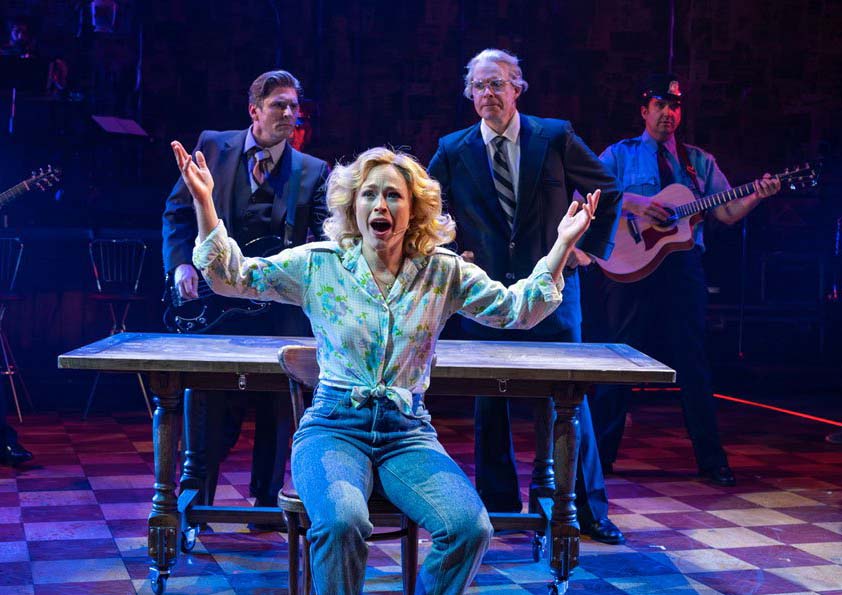
The story is irresistible, really: Lawrencia Bembenek, Milwaukee cop, playboy bunny, convicted murderess, escaped felon—and maybe framed? Villain or victim? It has everything: crime, sex, betrayal, corruption . . . it was a big fat slice of Wisconsin sleaze, and it was irresistible to the local press back in the early 1980s too. It just begs for a big trashy musical, doesn’t it? And who better to write the score than Gordon Gano of Milwaukee’s cult band Violent Femmes, whose small-town dysphoric sound won their own fame in the 80s. So, after a decade-long gestation, a show is born: Run Bambi Run, a collaboration by Gano, Milwaukee Rep’s Artistic Director Mark Clements, and acclaimed playwright Eric Simonson of Chicago’s Steppenwolf Theatre. The musical is currently playing in it’s world premiere at the Rep.

And what a show it is: a raucous, rowdy panorama of Milwaukee’s seedy side, detailed and razor-satirical as any painting by Breughel or Hogarth, or a comic by R. Crumb. The Milwaukee Chamber of Commerce is not likely to love it; our city looks like a mean, corrupt, and tawdry place from its gutter perspective, which summons a cast of caricatures from the tabloids, sprung to life for our prurient pleasure. Headlines blaze from big screens; timelines flash as the story propels us along Bembeneck’s lurid career with the queasy inevitability of a Greek tragedy: the flawed hero hurtling toward her predestined doom.

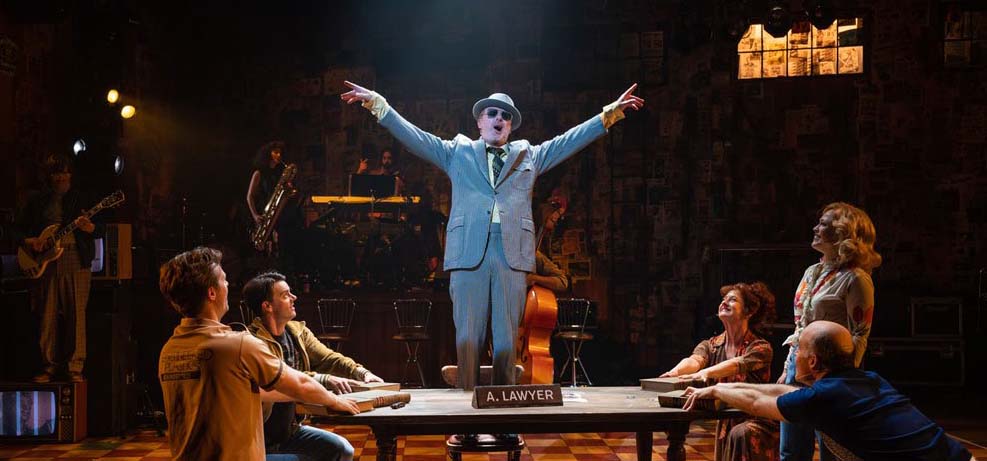
But for all the show’s initial teasing of “is she guilty or is she not?,” the book, based on contemporary accounts and later research, unambiguously takes Bembeneck’s side. It tracks us through her entire hapless career: every poor choice in relationships, advice not taken, and imprudent decision, to make a pretty convincing case that, even if she was not set up by her scumbag husband, her faithless best friend, her crooked attorney, and the collective animus of the Milwaukee Police Department—who are definitely not Milwaukee’s finest—she was undoubtedly outplayed in a game that she was underpowered for from the start.

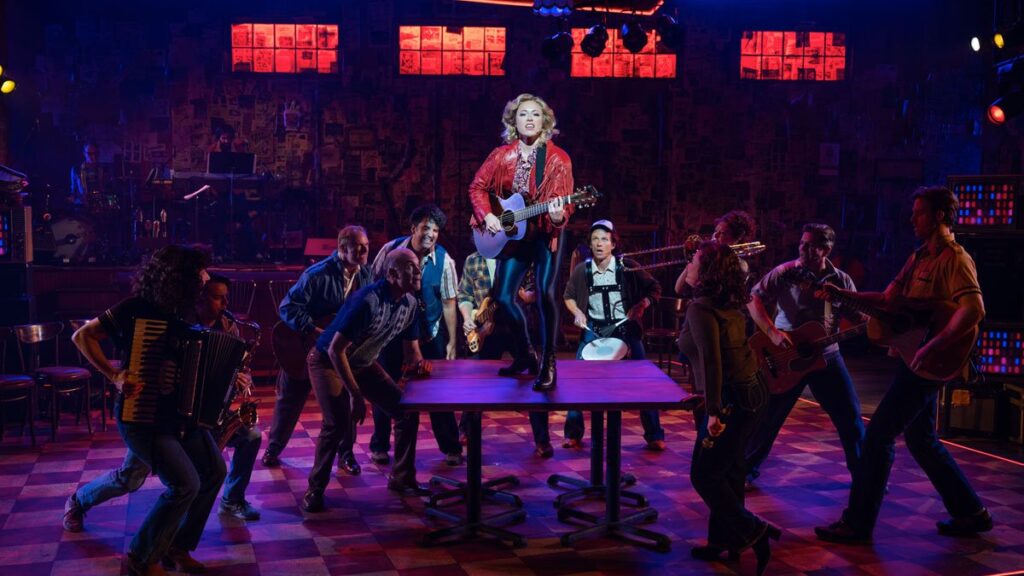
Under Clements’ direction, the show assaults us with bright lights, loud music, and the feverish energy of 12 pumped-up actor/singer/dancer/musicians who play their own instruments excellently while in character—a signature feature of Clements’ musicals—under the brilliant music direction of Dan Kazemi. The music is amped so high that earplugs are available in the lobby (I recommend them for Act 2 especially).

photo by Michael Brosilow

Gano’s score, which sometimes veers into the sung dialog of rock opera, recalls the Femmes’ jangly post-punk intensity: the opening number, set on New Year’s Eve in Tracks tavern, is truthfully entitled “The Seventies Sucked.” Gano dips into other styles: a comic “bad roommate” polka, a sentimental ballad to Kosciusko Park, a leering commercial for Lake Geneva, and a roaring Jerry Lee Lewis showstopper rocked out by Douglas Goodheart as the bouffant-headed attorney Don Eisenberg. Lyrically, Gano follows less Sondheim or Lloyd Webber than Iggy Pop, whose dictum was to stick to words of one syllable. The lyrics’ blunt simplicity complements the monumental stupidity of the show’s milieu, though they often tell us no more than we already know rather than offering any counterpointing perspective.

Does Run Bambi Run critique the grotesque Bembenek circus, or does it partake of it? Two moments cut through the clown show to the emotional truth; curiously, they both feature actress Sarah Gliko, who plays two minor but important characters. One is in the courtroom, when the murdered woman’s son, the only eyewitness to the crime, testifies: Gliko, as his mother, slowly crosses the stage like a Shakespearean ghost, singing “Remember me.” In the other, she plays a reporter interviewing the indefatigable Erika Olson’s 52-year old Bembenek: now free, but weary, sick, and maimed from a bizarre escape attempt. “On a scale from one to ten,” the reporter asks, a bit heartlessly, “how would you rate your life?” Bembenek replies stoically, “I’d give it a two.” A whole life of potential, wasted in bureaucracy and broken promises, divided, subtracted, and summed up into one dreary number. (Note to the producers: during the intermission I met a former Wisconsin attorney who had socialized with Bembenek; he said that she never used the contraction “ain’t.” Despite growing up on the South Side; fancy that.)

But the show can’t leave the audience on such a bummer ending. Rather like another true crime musical it much resembles, Jesus Christ Superstar, it resurrects the 23 year old Laurie for a final rousing number, celebrating her as a hero who never gave up the fight for truth and justice.

photo by Michael Brosilow

I think Run Bambi Run has a great show in it. Given an artful reckoning with its inner contradictions, and a bit of streamlining of its excess bulk, it could go far. Is it really good to have fun with such a fundamentally sad story? Does the show’s carnivalesque approach celebrate its protagonist as a feminist martyr, or does it feed off the gawker mentality that dogged her entire life? This is a more interesting question than whether she “did it” or not. In the end, the viewer must be the judge.

The Milwaukee Rep  presents

Run Bambi Run

A New Rock Musical

Book by Eric Simonson
Music and Lyrics by Gordon Gano
Directed by Mark Clements

playing through October 22

www.MilwaukeeRep.com