All posts by jgrygny

On seeing Les Misérables for the first time

Photo by Matthew Murphy

by Jeff Grygny

It’s been 40 years since  Les Misérables first opened on the London stage, Critics panned it as lightweight, sentimental, and clichéd. The public thought otherwise and the show has become a beloved international institution. Despite my decades in the theater, I somehow managed to dodge this theatrical dreadnought. But the world is simmering with discontent, and the stars are in the same place as they were in the revolutionary period, so I thought it was time to check out the touring production, to hear the voice of the people for myself. Here’s what I got out of this  vieille grande dame of musicals:

First off: woops! I thought this would be about the French Revolution. It was all the flag waving, barricades and “I hear the people sing.” Turns out there was more than one French Revolution; this one takes place decades after the storming of the Bastille. There will be no singing of La Marseillaise tonight!Not only that: the aristocracy has fallen, sort of, the people have risen up—and things are still awful. Poor people still wear dirty rags; the hero, Jean—sung with great purity and intensity by Nick Cartell—spends 19 years as a slave because he stole a loaf of bread, and now it’s the people themselves who are being jerks. The slave master, a fellow named Javert, humiliates Jean, insisting on calling him only by his number. Meet the new boss, same as the old boss.

Photo by Matthew Murphy

But Jean catches a break when a kind priest shows him outstanding charity—twice! By the way, this show looks and sounds great, not just for a touring production but for any stage production. Stage pictures tell the story with energy; the singing is powerful; the music overflows with feeling right from the start.

The cast is obviously pro. Even though some of them are fairly new to this tour, they hit their marks and belt their hearts out. No phoned-in performances here! It’s as if they understand the show’s relevance to our current moment as a nation. Even though the music might be the sonic equivalent of a Thomas Kinkade painting, and you can often predict what the next rhyme will be, it’s unquestionably well-crafted and beautiful, the melodies weaving into each other as the characters grow in their relationships. The 15 piece orchestra sounds full and rich. There is an inevitable sense of repetition, as the cast is executing a formula that has been honed and perfected. But they are committed to giving the audience what they came for, and give it their all; it’s almost like a religious ritual: each note and step prefigured and set in tradition. It takes on the tone of a master storyteller reciting a treasured cultural epic.

Photo by Matthew Murphy & Evan Zimmerman for
MurphyMade

Oh wow—it looks like Jean sold the silver the priest gave him, got decent clothes, and worked his way up to becoming the owner of some kind of factory that employs a lot of women. One of them gets fired for resisting a lustful supervisor’s harassment, ends up as a prostitute, is discovered dying in the street by Jean, and dies soon after. All in the course of ten minutes. This show really moves, and I’m not complaining. Huge set pieces unfold like pages from a giant pop-up book. Artful projections give the stage a painterly feel (apparently they were inspired by drawings made by Victor Hugo himself). It’s one gorgeous image after another—even the squalor is picturesque. It turns out the woman’s little girl is being kept and abused by a scumbag innkeeper and his equally scumbag wife, played with villainous relish by Matt Crowle and Victoria Huston Elem. This leads to a very entertaining ensemble number in which Crowle struts, swans, and makes very creative use of his tongue. Jean finds the girl, Cosette, and takes her back to Paris. (The innkeeper fleeces him blind, of course.)

Whoa, who are these guys? This show doesn’t hold your hand, narratively. From their youth and the way they keep going into rousing anthems, I’d say they were a band of student revolutionaries, committed to resisting the powers that be, and trusting that the people will rise up behind them and create a better world together. One of them, played with drunken panache by Kyle Adams, seems to be skeptical of this project, though he hangs around them anyway.

Oh—Cosette is all grown up now, and played charmingly by Alexa Lopez. She sees one of the students, Marius (pronounced “marry us”), beautifully sung by Peter Neureuther, on the street and they instantly fall in love. And Jalvert, now a police officer, is still looking out for Jean—they are both looking a little grey by now—and he explains his mania for the law in a show stopping solo, in which the stars glow brighter and the light beams down on him like divine justice. Nick Rehberger knocks it out of the park.

Photo by Matthew Murphy

You get the idea. Victor Hugo, who wrote the original story, was a great humanist as well as a prolific writer. He stood up against kings, slavery, war, and despotism, He stood for freedom of expression, universal suffrage, and government by the people’s representatives. In this regard you could rightly call him politically liberal. But for all that, Les Misérables is deeply conservative: it does not place great hope in elite movements, but finally in the sense of justice that all men and women carry in their hearts, which they can find if they look deeply enough.

“Les Miz” isn’t what I thought it would be, and it’s a damn fine 3 hours of musical theater, with excellent talent and breathtaking stagecraft—even without the famous revolving stage. It’s moved and inspired countless people. And justly so.

Cameron Mackintosh

presents

Alain Boublil and Claude-Michel Schönberg’s

Les Misérables

Music by Claude-Michel Schönberg, lyrics by Herbert Kretzmer and original French text by Alain Boublil and Jean-Marc Natel

Additional material by James Fenton

Adaptation by Trevor Nunn and John Caird.

Broadway Marcus Center

playing through November 2

Want to get updates every time a new review is posted? Just send an email to:

playonmke@gmail.com

with the heading SUBSCRIBE ME

And you will be added to our contact list. Your contact information will be used for no other purpose than to give you reportage and analysis of the most cutting-edge, challenging, and inventive theater in Milwaukee!

Stay Human

Photo by Jake Badovski, Kłamię Studios

by Jeff Grygny

Do you get the feeling that everyone is out for blood these days? The air seems so heavy with rage, resentment, mutual incomprehension, and a general sense of doom, it’s no wonder millions of people are in some way or other prepping for the apocalypse.

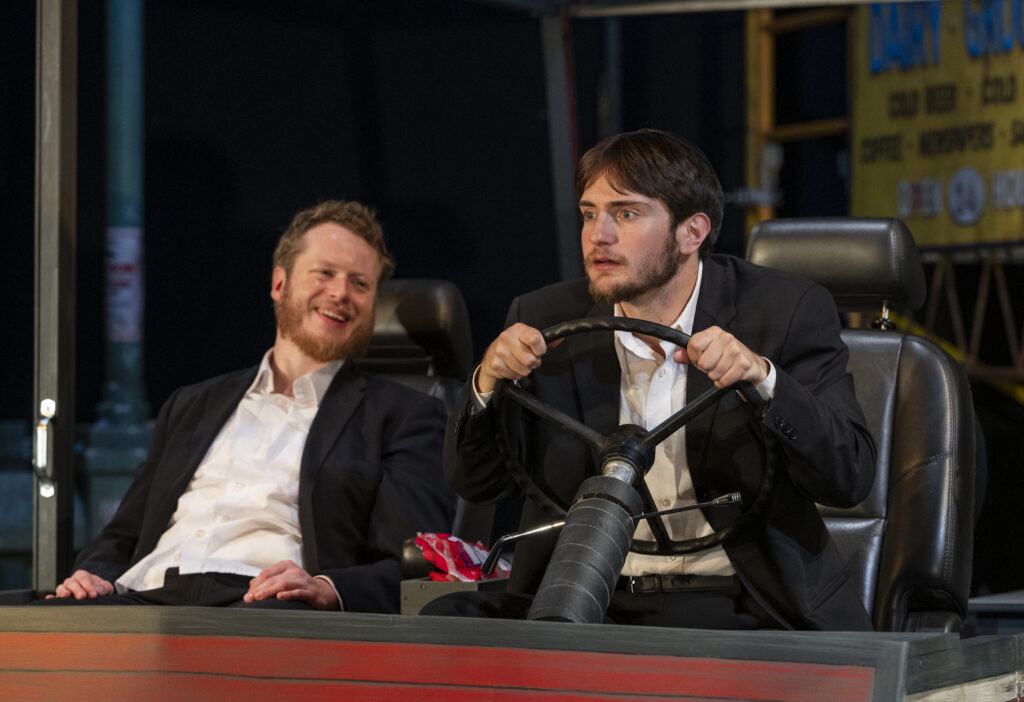
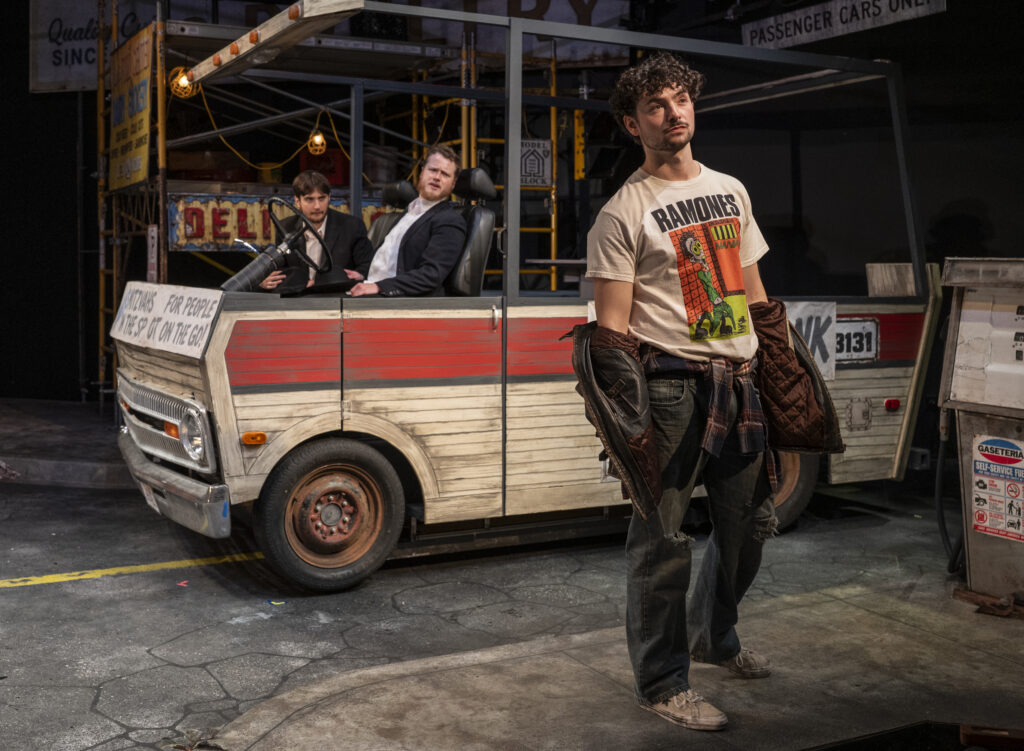
The artists of the Constructivists, with their characteristic punk predilection for showing civilized people devolving into savagery, have decided that it’s time for a comedy! A farce, no less. Hence their latest offering, Bed and Breakfast Of The Damned, a horror/comedy currently in its world premiere at the Broadway Theater Center. And though part of me wishes that few people find it in themselves to laugh at such horribly damaged characters, it’s a daring, provocative, and grotesque spectacle that seems perfectly calibrated to our current historical anxieties. It really takes you on a harrowing ride—I’d not recommend it for children, elderly relatives, or the easily triggered.

Playwright Cameron McNary has given the artists a nearly impossible task: to bring a fresh spin to the well-worn zombie trope, and to render its horrific events in the guise of a classic bourgeois bedroom farce: an I Love Lucy episode full of misperceptions, desperately improvised lies, embarrassing contortions, and many doors opening and slamming shut. Director Jaimelyn Gray has had to walk a hair-thin line: too naturalistic, and it becomes horror, too goofy and it’s just a bad cartoon. But how do you find the funny side of human beings turning into mindless flesh-eating abominations while keeping the core of true comedy: that the character’s emotions are real, if only for them?  

Photo by Jake Badovski, Kłamię Studios

The setting, as crisp as a Magritte painting, is the sturdily-reinforced common room of a pug-themed B&B. Round-eyed scrunched-up faces peer out from every pillow, throw, and picture frame, as if we are the performers for this mute audience, staring at us while the grisly events unfold. The stage business depends so much on characters not seeing things that are happening right in front of them, it strains credulity. But it gets a pass, since they are all clearly suffering from PTSD—not an obvious fountain of laughs, but there is is.

If acting is like setting yourself on fire in front of an audience, this cast is blazing. They really rise to the challenges, navigating the most awkward and over-the top scenarios without missing a beat. There is a tendency to signal “humor” with high-pitched urgency; everyone clearly has the chops to finesse the challenge, if only they stop trying quite so hard to be funny as they did on preview night. And, though they display the outsized emotions and exaggerated mannerisms of farce, they might just as well be presenting stylized images of people so traumatized that their rendition of “normal”  skews into gross caricature. After all, they have all “seen things” that would drive anyone mad.

Photo by Jake Badovski, Kłamię Studios

It’s not spoiling much to say that Molly Kempfer’s character is infected quite early on: her creative vocalizations as she’s “turned” by an unseen mob are so peculiar, it’s hard to know if they’re horrific or hilarious (she also makes the most adorable zombie you could imagine).  Burdened with the script’s most strained gags involving pugs and gift baskets, Matthew Scales gives us the B&Bs alternatively manic and narcotically blissed-out proprietor with a surprising core of truth. Ken Miller and stacymadson [sic] play the most severely psychopathic characters: he has a survivalist’s paranoid ruthlessness; she is even scarier, with her Joker’s grin, sexually preying on her housemates “like a cobra in a room full of hamsters.” (Intimacy coordinator Laura Sturm earns kudos for coaching the players through some really emotionally risky moments). Phillip Steenbekkers and Becky Cofta give us a baseline of what passes for normal in the End Times; they show us the play’s version of heroism at the end of the world, not by rushing into danger, but just by making the effort to cling to the shreds of their humanity.

Whether you find Bed and Breakfast of the Damned funny or scary, amusing, appalling, outrageous, or any combo thereof, the real meat (pardon the expression) of the production is in this heroism of holding onto your humanity when everyone around you is losing theirs. As our world sinks ever deeper into the unthinkable, this is the cadence that the off-beat comedy hammers in with surprising force: please stay human. Don’t let the craziness let you become predatory, ruthless, disassociated. Don’t turn on your friends, or attack your potential allies, even if they’re a little crazy too. And above all: LOOK OUT THEY’RE RIGHT BEHIND YOU!

Bed and Breakfast of the Damned

By Cameron McNary

directed by jaimelyn gray

October 25-November 7, 2025

Thursdays-Saturdays at 8pm, Sundays at 4pm

Studio Theater, Broadway Theatre Center, 158 N. Broadway, Milwaukee WI

TICKETS : https://www.theconstructivists.org/productions/25-26-season/bed-and-breakfast-of-the-damned

“This production contains adult subject matter. Viewer discretion strongly advised. We believe in the power of dark art catharsis. As such, every Constructivists production contains provoking words, ideas, and actions. We respect everyone’s boundaries, but also respect those who wish to know as little as possible about this production. General warnings are violence and language.”

Want to get updates every time a new review is posted? Just send an email to:

playonmke@gmail.com

with the heading SUBSCRIBE ME

And you will be added to our contact list. Your contact information will be used for no other purpose than to give you reportage and analysis of the most cutting-edge, challenging, and inventive theater in Milwaukee!

A Cool Ocean Breeze

photo by Mark Frohna

by Jeff Grygny

Operas are not generally famous for being tethered to realism, including, of course, Gilbert and Sullivan’s works, which float weightlessly on the inflated self-image of Victorian fantasies—while still not being too timid to fling the occasional satirical dart. One of their most celebrated creations, H.M.S. Pinafore, is best known these days to long-time fans of The Simpsons as the show Sideshow Bob forces Bart to listen to—cementing it as an icon of effete cultural out-of-touchness. 

Last week Milwaukee Opera Theatre’s Jill Anna Ponasik, in collaboration with Jeffrey Mosser and the UWM Theater Department, presented an “adaptation”  that’s rooted in Victorian England roughly in the way a teddy bear is related to a real bear: the same general shape and proportions, just rounder, fluffier, and somewhat less dangerous. This is fine since, as far as it’s cast of undergraduate theater majors is concerned, the original mileau is so remote, from their perspective, it might as well be set in Katmandu. Not to worry, though: Ponasik brings her usual whimsy to concoct a show that’s light, diverting, and full of the joy of music. Everyone embraces the silliness with an open-hearted sense of fun, clowning it up without trying too hard. And, crucially, they don’t make fun of their character’s feelings, however ridiculous they might seem.

photo by Mark Frohna

Through it all, Music Director Donna Kummer and her accordion lead a mighty four-piece ensemble; together they create a rich, full sound with an old-time nautical feel. Similarly, the simple lines and bright colors of the set by Christopher J. Guse and costumes by Jason Orlenko at times recall the old Max Fleischer Popeye cartoons (I haven’t seen bustles onstage in forever; Orlenko has crafted an ingenious design that the actors can sit on without looking awkward). There’s a bit of a surf comedy vibe in the air as well, plus, more topically, maybe a whiff of anime’s romantic turbulence and outsized emotions. For a while there’s a modest attempt to bring the setting into turn-of-the-century Milwaukee, with a few lyric changes and costume choices, but nobody takes it too seriously, and it doesn’t last long.  The chorus has excellent diction, which is great, because some of the leads could have given their consonants a bit more attention.

The story concerns the perfectly clean and nice titular ship, where there’s absolutely nothing wrong going on—except for three things: a shady looking sailor with the intimidating name of “Dick Dead Eye”— played with scurvy brio by the most excellently-named Ryder Ruck —is hanging around, seemingly up to no good. Then, the finest sailor in the fleet, a lad named Ralph Rackstraw for some reason, loves the captain’s daughter Josephine, but as a captain’s daughter, she is beyond his social station. Finally, the Captain— a fearless leader who is “hardly ever sick at sea”— has betrothed Josephine to the egocentric Lord High Admiral. Much weeping and musical baring of hearts ensues.

photo by Mark Frohna

Josh Thone plays Ralph with a fine sense of musical comedy: rather like a young Donald O’Connor, his gangly charisma makes him a hero you can cheer for. In the role of Josephine, Serena Vasquez, looking a bit like Olive Oyl (it’s the shoes), sobs and sings equally sweetly, with a touch more fire than your standard issue English heroine. The Lord High Admiral, who delivers one of the most famous patter songs in musical history (you know, the one that did not amuse Queen Victoria), is most amusingly rendered by the strong-voiced Nathaniel Contreras as an entitled nepo baby in mirrored glasses and pink Bermuda shorts. 

photo by Mark Frohna

It’s crammed with enough shtick to keep all but the most attention-challenged viewer entertained: the players quote popular dance moves, indulge in goofy stage business, and scatter little jokes into their songs—such as when Austin Franz as the Captain carefully unpacks a euphonium to accent his woe with an occasional mournful blat; or a trio who athletically trade off a gratuitous concert triangle in a fast-paced ditty. Before the curtain metaphorically falls, many shocking secrets are revealed, which conveniently solve everyone’s problems (patrons familiar with the show had a few extra surprises coming.)

With H.M.S. Pinafore, as with their many other productions, Milwaukee Opera Theatre fulfills their mission of dismantling the barriers between opera and audience. At it’s best, the production is a tuneful trifle, a cool breeze that refreshes and cheers us. And everyone involved seems to have had a jolly good time—nothing wrong with that!

Milwaukee Opera Theatre and

UWM Theater department present

H.M.S. Pinafore

Book by W.S. Gilbert                         Music by Arthur Sullivan

October 8 through 12, 2025

Creative Team

Co-Directors – and Jeffrey Mosser

Music Direction – Donna Kummer

Choreographer – James Zager

Scenic Designer – Christopher J. Guse

Costume Designer –

Cast

Ralph Rackstraw – Josh Thone

Josephine – Serena Vasquez

Sir Joseph Porter – Nathaniel Contreras

Captain Corcoran – Austin Franz

Dick Dead Eye – Ryder Ruck

Musicians

Guitar – Max Williamson

Accordion/Piccolo/Flute – Donna Kummer

Bass – Hannah Sternberg

Recorder/Oboe – Charlie Marsh

Want to get updates every time a new review is posted? Just send an email to:

playonmke@gmail.com

with the heading SUBSCRIBE ME

And you will be added to our contact list. Your contact information will be used for no other purpose than to give you reportage and analysis of the most cutting-edge, challenging, and inventive theater in Milwaukee!

EARTH ART MAGIC

photos by Jeff Grygny

by Jeff Grygny

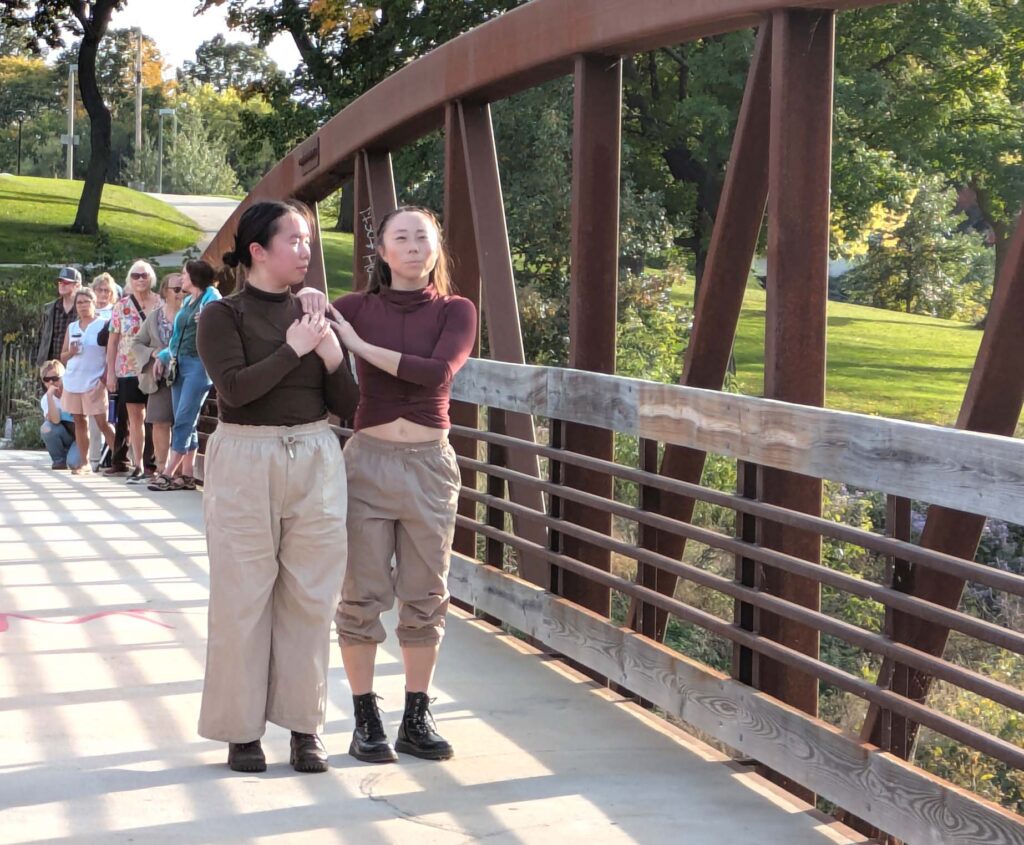
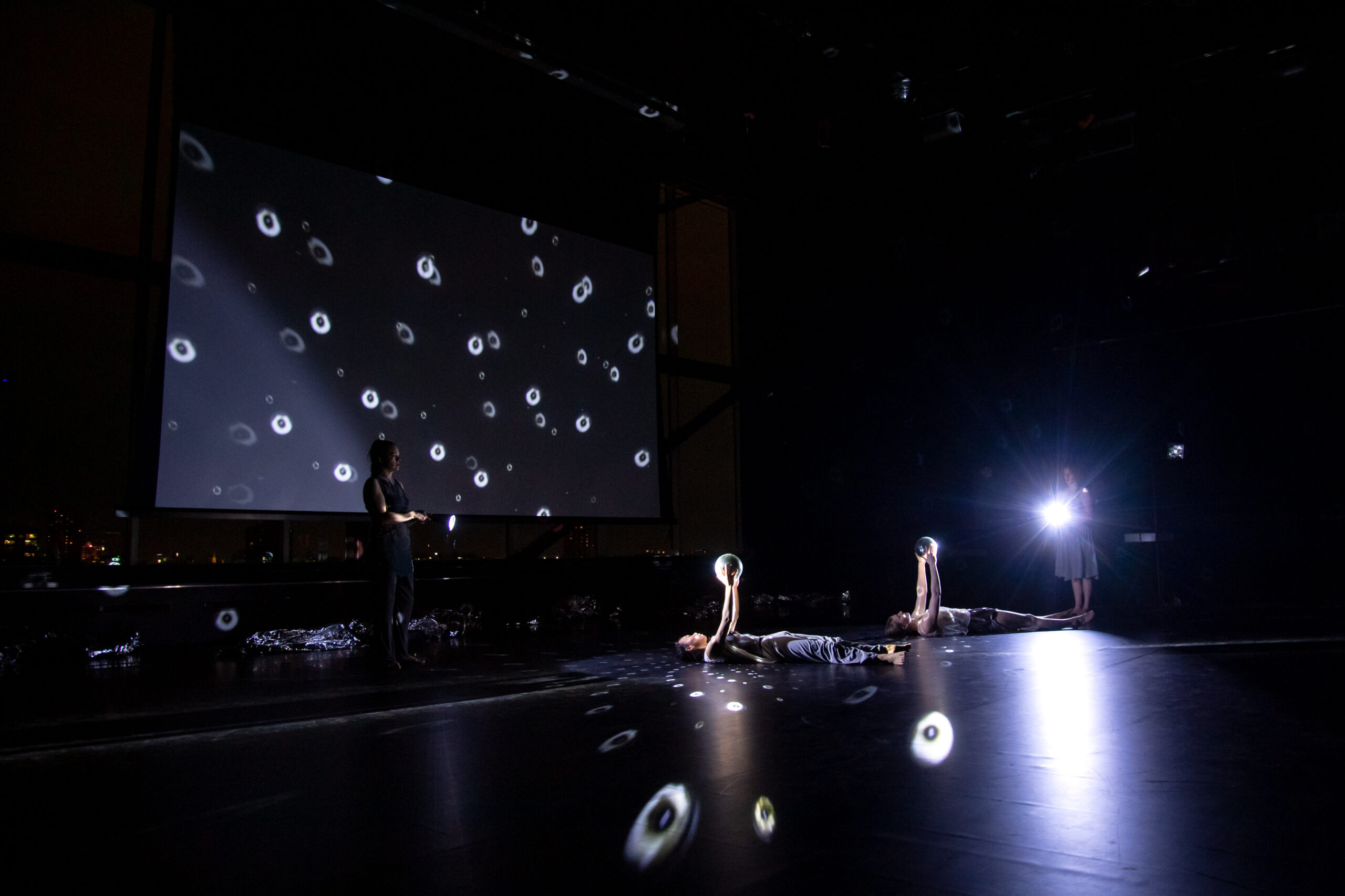
You’re walking down a torchlit path with people you don’t know. The night clouds glow with reflected urban light. You notice odd sounds coming from the darkness to your left: shadowy figures, neither human nor animal, are tracking your course, their bulky shapes bristling with long, fan-like spikes. Where the paths cross, a man in red is praying–or is he having a seizure? He mutters, twisting and bending with jerking movements. You start to lose track of what real: that rhythmic sound in the tree—is it a cicada? Or a hidden speaker? That sound—is it the wind rustling the leaves? Or is it part of the ethereal sonic atmospheres created by a woman sitting on the ground by the side of the path, moving her hands over some instrument? A woman in blue emerges into the light; the man and his red-clad cohorts step back; they sway as she dances alone, sadly and slowly. At last the man and the woman both leave, going down different paths.

Is this a dream? A hallucination? It can be hard to tell sometimes during Field Guide, the latest in Wild Space Dance Company’s In Site series of works created for specific places, in this case, Havenwoods State Forest, the only state forest within the City of Milwaukee. This enchanting immersive performance takes the audience from place to ingeniously-lit place within the park, and under the steady direction of Artistic Director Dan Schuchart, it’s a tour-de-force of creative, technical, and logistic imagination: the most daring and original adventure in the performing arts our city has seen in years. And like all good art, it stirs up many thoughts. feelings and senses, which will not necessarily be the same for any two people.

This magical work is produced in collaboration with Ometochtli Mexican Folk Dance company and musicians from the Out There performance group, which organizes outdoor avant garde concerts. It’s an impressive bringing together of different cultural traditions and artistic vocabularies that somehow, magically, creates something exceptionally moving and powerful.  Throughout it all. the night time woods and prairie provide not only a fantastic setting for the dances, but are also full of numinous presences that are palpable, if not always visible, characters in their own right.

The evening opens with a grand demonstration of this alchemy: the Wild-Space dancers enter a wide open field, running, interacting, mirroring and varying each other’s movements. They approach the audience and speak about things they have encountered on the land, not by naming them, but with poetry that melts into movement. Then, women of Ometochtli enter in traditional garb, carrying ribbons of different colors which they skillfully weave into kaleidoscopic patterns, which is apparently an art that goes back to pre-colonial times. The two groups move among and around each other, weaving the modern and the traditional in ways that express their humanity while holding the integrity of their own cultural languages. It’s beautiful  to see—and incredibly moving.

The audience divides into two groups, each following a guide with a luminous baton along winding trails and into different prepared performance spaces. I don’t know if both groups see all of the performances: our group could hear the drumming and cries of Ometochtli as we moved between sites. But we did witness other visions: dancers suspended from an ancient tree by ropes, launching themselves airborne and dancing on the tree’s trunk as if it were the ground; and then a palate-cleansing interlude involving sand and changing spatial and emotional relationships, to live violin accompaniment. On our way to the final act we were met with the sweet fragrance of burning copal wood, and the forceful drumming and conch-trumpets of a procession by the dancers of Ometochtli, coming to meet us in full regalia of spangles, feathers, and ankle-bells. It was an unforgettable dramatic moment in an evening of surprises—and surprise, after all, is one of the indispensable qualities of great art.

The conclusion was a traditional Aztec ceremony blessing the six directions: East, South, West, North, Above, and Below. To say that in no way captures the visceral impact of the ritual. As a modern observer, one might experience a web of complicated feelings: a sense of touristic consumerism, perhaps, as we raise our cameraphones to record the spectacle; a sense of enormous gratitude to the dancers of Ometochtli for sharing their precious cultural heritage; an uncanny disconnect between modern dance, with its deep orientation to individual experience, and the traditional dance, which honors community and continuity; a sense of wonder at the harmonious interplay of the two; sorrow, anger, and fear for the people who are even today being ripped from their homes and families by a cruel administrative machine; and a sense of awe, as the customs of a distant land bless and empower the land beneath our very feet, land that has been inhabited by a different indigenous people, then colonized, farmed, turned into a prison, then a base for fearsome weapons, and now restored to a semblance of the natural world.

We modern people, by default, see nature as scenery, a pretty luxury getaway, or even as an inconvenience. For every other culture in the human story, the natural world is a society of beings, on whom we depend for our very lives. The traditional view is closer to the truth, of course: the founding ecologist Aldo Leopold wrote  that we should not see the land as something that we own, but rather as a community that we are part of. It may be that our future depends on becoming more like indigenous people—not by imitating their lifeways, but by exploring cultural practices that transform the impersonal, exploitive relationship with the living world that we inherited from the materialist culture we grew up in.Wild Space gives us a brilliant picture of how this can happen.

Ecological scholar Roy Scranton has written that “ …the narratives and meanings we associate with the natural world are never simply given nor inherent, waiting to be revealed . . . [They] are cultural, taught, passed down from one generation to the next, revised to accommodate new evidence, molded to serve political needs, and warped by social currents and mass emotions, all the while evolving through their own poorly understood dynamics and trajectories.” Which is to say, our relationship with the living world is permeable to needs and influences, even deliberate intervention, using the instruments of cultural transmission, like education, advocacy— and the arts!

As events beyond out power thrust us into an uncertain future, socially, technologically, and ecologically, creative, cultural exchanges and cross-pollination like this Wild Space performance are priceless models for how to per-form a new culture for our children and their children’s children. In this way, Field Guide is a luminous signal, guiding us through our modern wilderness towards a more harmonious way of human life on Earth.

Wild Space

in collaboration with Ometochtli Mexican Folk Dance

presents

InSite: Field Guide

October 10 and 11, 2025

Choreography by:

Katelyn Altmann, Cuauhtli Ramírez Castro, Ash Ernesto, Zoe Mei Glise, Alejandra Jiménez, Elisabeth Roskopf, Dan Schuchart, and in collaboration with the dancers

Music Direction and Live Performance by:

Lorna Dune, John Larkin, Allen Russell, Antonio Velázquez

Lighting Design & Stage Manager:

Colin Gawronski

Technical Director:

Tony Lyons

Tech Crew & Docents:

Maria Shanklin, Rae Zimmerli

PERFORMERS:

Ometochtli: Favi Álvarez, Leah Colchado, Ash Ernesto, Angelica Escamilla, Norma Gonzalez, Alejandra Jiménez, Mariela Jiménez, Laura Medina, Jaquelin Moreno, María Pérez, Yarely Ramírez, Alejandra Rodríguez Ortega, Antonio Velázquez

Wild Space: Katelyn Altmann, Emma Becker, Audrey Dudek, Angela Frederick, Cuauhtli Ramírez Castro, Ashley Ray Garcia, Zoe Mei Glise, Jessica Lueck, Jenni Reinke, Elisabeth Roskopf, Nicole Spence, Jasmine Uras

Want to get updates every time a new review is posted? Just send an email to:

playonmke@gmail.com

with the heading SUBSCRIBE ME

And you will be added to our contact list. Your contact information will be used for no other purpose than to give you reportage and analysis of the most cutting-edge, challenging, and inventive theater in Milwaukee!

Alchemy for Beginners

photo by Michael Brosilow

by Jeff Grygny

“When are we going to start acting?” So complains a character two thirds into Circle Mirror Transformation, currently playing at Next Act Theatre. For three weeks she’s been taking an acting class at an adult community center in a small white-bread town in Vermont, and they’ve been doing a lot of things, very few of which could be conceivably called “acting.“ It’s a question that must have been posed by countless acting students at some point in their training.

For a century, teachers like Constantin Stanislavsky, Viola Spolin, Stella Adler, and their descendants have been getting their students to lie on the floor, toss imaginary balls, talk gibberish, gaze deeply into each other’s eyes, and plumb the depths of their traumas, all in the quest for authenticity in the unnatural act of “doing private acts in public.” This is likely to interest the average theatergoer as much as the details of training to be a plumber or computer programmer. But the playwright, Pulitzer, MacArthur-winning Annie Baker uses the premise like a biologist’s microtome, slicing wafer-thin cross-sections of life and microscopically examining them in a laboratory setting. How this reveals her characters’ lives is compelling, if not revelatory.

The play pulls us into its origami-like structure. Baker breaks the action into short scenes, apparently in linear time, but with enough space and discontinuity to make them seem haiku-like, with most that is essential remaining for us, the audience, to fill in. It’s like the theatrical version of experimental artist Sol Lewitt’s “transformations,” in which he’d tear up drawings and rearrange the pieces to create something new. Here, Baker’s material is ordinary life refracted through theater games, as the students warily move in and out of their comfort zones, hiding or revealing themselves. But the transformations are also psychic: the class becomes like an alchemist’s retort, where souls are stressed, dissolved, recombined, and reassembled. Relationships form and fall apart; illusions are confronted and released.

It takes a remarkable set of actors to manifest this vision, and under the finely-calibrated direction of Cody Estle, the cast pulls it off with grace and flair. Each one of the five performers has lovely moments that show, in the subtlest of ways, what’s going on in the fictional people they’re embodying; perhaps especially when they have moments alone, often interacting with the wall-length mirror that forms the backdrop of Jeffrey D. Kmiec’s naturalistic set. Estle presents the vignettes as if they were a fastidiously-arranged Instagram page, an impression enhanced by Sound Designer Josh Schmidt’s musical interludes, which start out with fussy perfectionism and gradually blossom into resonant feeling, as the characters transform into more three-dimensional versions of themselves.

Of course, like alchemy, there’s always been a whiff of flim-flammery around actor training. There are times when Marty, the teacher, played with marvelous nuance and humor by Tami Workentin, leans so heavily into psychodrama that you wonder about her motives, and why everyone keeps coming back. There’s a genuinely harrowing sense of emotional danger in these scenes. Why would anyone do these strange, uncomfortable things?  Marty  gives her answer: “it’s to learn how to not second-guess yourself and the people you’re with.”  Which is not a bad skill for anyone to have, show person or not.

In her production notes, Baker exhorts the actors to keep all the pauses as written, and resist the temptation to keep the action moving. L_k_  a  s_n_t_nc_  w_th  th_  v_w_ls m-ss_ng, you fill in the gaps and make meaning, participating in the story yourself. Estle take this idea even further adding quite long blackouts where we sit in the dark just listening to the music. The two-hour, no-intermission show could have been quite a bit shorter. But would it then have the same power to work on us?

A bountiful hybrid of realism and avant-garde, Next Act’s  Circle Mirror Transformation cannily enlists us in creating its illusion of truth. It’s a fascinating exercise in realism: in the playwright’s words, “a strange little naturalistic meditation on theater and life and death and the passage of time.” It’s an extraordinary play about ordinary people in a unique situation. Afterwards you might find yourself fantasizing about enrolling in an acting class yourself—or perhaps resolving to never, ever set foot in one.

Next Act Theatre presents

 Circle Mirror Transformation

by Annie Baker

playing through May 18

Want to get updates every time a new review is posted? Just send an email to:

playonmke@gmail.com

with the heading SUBSCRIBE ME

And you will be added to our contact list. Your contact information will be used for no other purpose than to give you reportage and analysis of the most cutting-edge, challenging, and inventive theater in Milwaukee!

Love, Death, and Family

photo by Michael Brosilow

by Jeff Grygny

Near the end of Milwaukee Rep’s extraordinary new production of Romeo and Juliet there’s a moment that focuses all its force in one wordless image.

WARNING: 400 YEAR-OLD SPOILERS FOLLOW

Romeo, played by Kenneth Hamilton, is returning to his home town of Verona, where he faces a death sentence because of his part in a deadly street fight. He’s heard that Juliet has taken her own life. He’s given away all his gold and purchased poison from a dodgy apothecary, and he intends to break into Juliet’s tomb and join her in death. Hamilton, approaching the stage down one of the aisles, turns and  looks back. His eyes tell it all: inconsolable grief, bitter despair, and above all, hatred for the world that brought him to this. It’s a hatred that destroys the soul, even as the spirit burns. The last 20 minutes of the play are postscript.

Playing in the 50 year old modernist elegance of Vogel Hall, with a single set on a proscenium stage, this production feels almost quaint in style. But in the execution, it’s fresh and bracing as your morning coffee. The direction is strong and the performers flesh the antique characters into real people. This is the finest Romeo and Juliet Milwaukee has seen in years—and the buzz among the opening night audience seemed to recognize it.

Love, hate, family: it’s the most famous of all Shakespeare’s plays; scholars say he was still polishing it near the end of his career. It holds some of the most famous lines in the English tongue, and the most amazing poetry, even crusted over by the centuries into cliché. The story could take place anywhere—well, anywhere young men fight vicious clan wars, and fathers regard their daughters as property. So, a lot of places. The challenge for any director is to grind off the sediment and reveal the beating heart of the tragedy, and this Director Laura Braza accomplishes handily, with the help of incredible music, played live by the performers under Music Director Dan Kazemi. Like their work in Much Ado About Nothing last year, they’ve cracked the Shakespeare code by deploying songs precisely calibrated to the setting to breathe life into the old theater warhorse.

This production is set in Appalachia, land of the Hatfields and McCoys, of feudal politics and family dynamics. The folk songs, with their metal strings and yearning voices, sing of hot days, lush woods, hard labor, and strong passions. The exact period is somewhat vague. It could be the late 1800s, but some artifacts and costumes suggest the present day. Let’s call it mythic  Appalachia, somewhere between the civil war and Hillbilly Elegy. It can seem jarring to hear these rustic folks toss off classical references like Oxford scholars, but remember: for a long time the most popular literature in America was Shakespeare and the Bible. They would be no strangers to high-flown rhetoric. Not to mention that some scholars argue that Elizabethan English may have sounded with the soft vowels of the southern drawl. Shakespeare’s lines pour like moonshine through the West Virginia twang.

photo by Michael Brosilow

In the first half of the play, Braza and Kazemi bring gorgeous music to evoke the emotional world of the play. The opening song is a ballad about meeting a woman’s ghost, that might have been transplanted from the Scottish moors. In this version, Romeo first sees Juliet while she’s singing a song at her father’s party. And there’s a lovely handfasting ceremony that might bring a few tears to your eyes. In her debut professional role, Piper Jean Baily shows us the teenaged Juliet as a lively, witty and perhaps over-imaginative girl, her gangly youth accentuated by Mieka van der Plong’s costumes. She and her Romeo have wonderful chemistry; you actually believe that they are made for each other. Harrison plays the consummate romantic, with a physique that might remind folks of a certain age of Al Capp’s Li’l Abner.

But we’re far from “The Dukes of Hazzard do Shakespeare” territory. Matt Daniels gives his all playing Lord Capulet as the bigger than life paterfamilias of a wealthy family. He’s the kind of voluble bearded guy you might find on a Kentucky road behind the wheel of his Silverado; genial when he’s pleased, terrifying when he’s crossed. Alex Keiper confidently straddles the choice role of Juliet’s nurse, betimes no-bull or full of dishy gossip. The show’s superpower is Chicago actor Matthew C. Yee’s Mercutio: a powerful, defining presence. His self-accompanied songs deliver dirt, sweat and savvy in a voice like Kentucky bourbon; his delivery of the famous Queen Mab speech is a genre unto itself: a man who can’t stop his imagination from running out of his mouth in escalating crescendos of fantasy. (It’s now one of my two favorite Mercutios, the other being 50 years ago: a hyperactive high school student, with a 15 year old Mark Waters, aka Sir Mark Rylance, playing Romeo.) Yee later beefs up a comic scene with a positively filthy ballad with innuendo so coarse it barely escapes being pornography. Also excellent is Nate Burger’s transformation into Friar Lawrence, a country parson-slash-herbalist, played with with gruff tenderness.

photo by Michael Brosilow

Braza evidently chose to make all the music diegetic, so there’s no music in the Capulet family tomb, where the two bright kids meet their terrible, stupid denouement. Whether or not this gives the scene more emotional power is up to the viewer to decide. There’s just perfect final reprise of the opening song. (Note to the producers: it would be nice to have a list of the songs with a bit of their provenance in the program.)

Clan wars seem to have always been part of the human condition, though nowadays they’re likely to be more based on ideological affinities than blood ties.  And in her classic book The Creation of Patriarchy, historian Gerda Lerner detailed how the cultural norm of men regarding women as property was a millennium-long process, its origins in ancient Mesopotamia with the rise of warrior kings. Anthropologist David Graeber, with access to more recent translations of cuneiform tablet hoards, elaborated on this story: he tells how the priests of Babylon monopolized production so much that workers were often forced to sell their daughters into temple prostitution to pay their debts (that was a thing in those days). So, many families abandoned the cities and struck out as nomadic tribes—with a fiercely-felt need to protect their women. (You can read all about it in Graeber’s eye-opening study Debt: The First 5,000 Years). So yeah, the story of star-crossed lovers bucking their society and losing is likely a tragedy as old as history itself. Only the music changes.

To Braza and company, I can but echo Jaques in As You Like It, and call out “More, I prithee more!”

Milwaukee Rep presents

Romeo and Juliet

by William Shakespeare

playing through March 30

https://www.milwaukeerep.com/shows/show/romeo-and-juliet

Want to get updates every time a new review is posted? Just send an email to:

playonmke@gmail.com

with the heading SUBSCRIBE ME

And you will be added to our contact list. Your contact information will be used for no other purpose than to give you reportage and analysis of the most cutting-edge, challenging, and inventive theater in Milwaukee!

The Light Side Of The Moon

photo by Mark Frohna

by Jeff Grygny

Milwaukee Opera Theater should be a lot more famous than they are. With modest funding, boundless imagination, and a vast love of opera, this mighty little company, under the inspired direction of Jill Anna Ponasik, has been staging some of the most innovative theater in town, year after year, reliably delivering that heaviest (and snootiest) of all high art forms in bite-sized, audience-friendly shows that are light, playful and, as far as this non-opera person can tell, musically excellent.

Last Friday, in the biggest winter storm of the year, a full house showed up for Rusalka, Antonin Dvorák’s most popular opera, produced in collaboration with Danceworks Studio Theater. (They first performed the show in 2023, now it’s remounted with new choreography.) It’s one of those doomed magic girl fables that were all the rage at the turn of the last century: Ondine, Les Sylphides, Swan Lake, Coppelia, and of course The Little Mermaid (see also Edgar Allen Poe and everything Gothic). Russalka has all of these in its lineage, though, as it’s based on Slavic lore, in an Eastern European mood.

Rusalkas are water spirits, known for their wild unruly hair and their proclivity for tickling people, sometimes to death. (I imagine generations of Slavic parents scaring their kids with stories of the invisible beings that tickle you while you’re swimming, then dragging you under.  The name “rusalka” apparently has nothing to do with the Rus, the tribe that gave Russia her name, but comes rather from the Latin name of an ancient festival of roses, held in springtime, the only time when the rusalka could leave the water, climb trees, and sing to the moon.) This typically dark fairy tale has one such spirit falling in love with a young prince and asking a witch to make her human, at the cost of her voice. Unlike the Disney version, this does not go well, and everybody ends up dead or miserable. But they sing beautifully.

Yet the show is anything but a downer. Ponasik, working with writer/performer Jason Powell, slices the 3 hour opera down to a very palatable 90 minutes, cutting scenes and characters, down to the heart of the story, A troupe of energetic dancers, choreographed in process with Danceworks’ Christal Wagner, populates the stage with a menagerie of strange and delightful creatures, each seemingly with stories of their own. This both lightens the mood and creates a universe for the story to live in.

photo by Mark Frohna

The moon is not a character in the original opera. “Mesiku na nebi hluboke”, known as “Song to the Moon,” is the most popular piece from Rusalka:  it’s the heroine’s “I want” song: praying to the all-seeing orb of the night to tell her love about her love for him (a favorite trope of the old heteronormative world). In this version Powell, clad in a white jump suit, fills the gaps in the story with witty Seuss-flavored verse and narrates in the beneficent, avuncular person of the Moon. He cheerfully confesses to “moon-splaining” the plot; later, his dialog spoofs a certain male infatuation with the sound of their own voice.

Three wood nymphs, sung by Tabetha Steege, Erin Sura, and Brennan Martinez, are the show’s power trio: they sing the operatic equivalent of shredding guitar every time they come onstage. Their three-part harmonies are like a shot of adrenaline to a comatose heart. Tim Rebers’ Prince is a slacker schlub who brings Rusalka to the palace, then quickly jilts her for a human girl known only as “a foreign princess,” here comically portrayed as a selfie-shooting influencer.

The show makes the most out of it’s tiny budget: Lighting Designer Colin Gawronski creates a artful palette of shifting atmospheres without grabbing attention; the costumes are ingenious and expressive: Rusalka’s sequined gown is practically it’s own character, glittering like her own watery nature even as she mourns her fate. In the title role, Saira Frank brings poise and poignancy without ever veering into bathos. Occasionally, the chorus slips into the generic happy/sad emoting that art of a certain period is prone to, but they add lots of little gestures and interactions that give them personalities: at one point, for instance, the witch Jezibaba’s familiar spirits take on the attributes of creditable wolves. For accompaniment, Music Director Ruben Piirainen mans the piano heroically, while Erin Brooker-Miller on concert harp adds the exquisite moods and grace notes in Dvorák’s lush score. They sound so full, you never miss the orchestra.

In anthropological terms, Rusalka, Jezibaba, the Wood Nymphs, and the moon himself are called “metapersons:” non-human beings whose actions play outsized roles in human fates, both for good and evil. Such beings are part of virtually every culture that’s ever lived—until modern times, taken out by the one-two punches of monotheism and scientific explanation. Yet we feel them still, and stories like Rusalka connect us with a very human, very un-modern way of living in the universe; surely part of their attraction for early modern artists, who could see the ancient ways melting away before them.

Once she’s alone, a spirit with human feelings, abandoned by her human love and her metaperson community, Rusalka forgives her prince in a final polished gem of an aria. Is this a story of a lost world, left behind by progress? Or of how humans, in rejecting their ancestral mythologies, are leading to our own doom? Or of the Freudian overtones of female adolescence in a patriarchal society? Or maybe it’s about the temptation of breaking with your provincial culture for a wider cosmopolitan milieu? If this particular show has any clear message, it’s “Girl, forget that boy; it’s better here where it’s wetter.”

photo by Mark Frohna

Milwaukee Opera Theater and Danceworks’ production doesn’t really say. What they give us is a reworked story, presenting its problematic aspects in brackets, as it were, turning the fascinations of an old, sick Europe into a beautiful fable, passing a cultural treasure to the next generation to shape to it’s own needs,  before they get lost in the junkpile of digital content.

In the moonlight, it all appears as a lovely, sad dream.

Danceworks Performance MKE in collaboration with Milwaukee Opera Theatre present

Russalka

Music by Antonin Dvorák

Playing through February 23

https://danceworksmke.org/concerts

Want to get updates every time a new review is posted? Just send an email to:

playonmke@gmail.com

with the heading SUBSCRIBE ME

And you will be added to our contact list. Your contact information will be used for no other purpose than to give you reportage and analysis of the most cutting-edge, challenging, and inventive theater in Milwaukee!

Scary Lady: The Woman In Black

Photo by McKittrick

by Jeff Grygny

What’s as cozy in the dark days of winter as a good old English ghost story?   

The vengeful spirit is a fearsome presence in the lore of many lands: the banshee, the Fox Spirit, Frau Holle, the Goddess Hecate. Denizens of the realms between life and death in feminine guise, their apparition is usually a portent of evil. And now it’s come to cast its spell on us: The Woman In Black, brought to Milwaukee by Mark Clements, The Rep’s Artistic Director, to bring us together in the bleak midwinter season, is just such a tale, featuring just such a spirit, and, as evident from the play’s 20 year run in London’s West End, it delivers the creeps artfully and irresistibly. Based on Susan Hill’s 1983 neo-gothic novella, and adapted for the stage by Stephen Mallatratt, the story has two filmed versions (one starring Daniel Radcliffe, no less), and has played on stages all over the world: proof that we like nothing better than a good scare.

It’s the account of the terrifying events witnessed by Arthur Kipps, a young solicitor appointed to order a recently-deceased woman’s affairs in the remote (of course) seaside town with the marvelously arcane name of Krythin Gifford. Rather than have Kipps simply narrate the play, as in the book, Mallatratt has added another layer of storytelling: he has Kipps enlist the services of an actor to help adapt his lengthy written account to present to his family, in hopes that it will rid him of the dreadful memories that still haunt him many years later.

At first, Kipps, played by Ben Porter on opening night (the players switch off roles for alternate shows), is a wooden performer. But as the Actor takes on the role of Kipps, Kipps himself warms to playing the other characters; he actually seems to be having a good time being someone other than himself (an experience that many actors can recognize). Then the mysterious lady of the title makes her entrance, and the haunting begins.

Photo by McKittrick

As staged by veteran London director Robin Herford, the production rolls along with all the tension, suspense, and gut-slamming shocks one could want, with the confidence of theater artists at the top of their game. Both Porter and Mark Hawkins, who played the Actor on opening night, build a rising sense of disquiet through subtle glances and ambiguous movements that suggest all is not as it should be. Hawkins seems to lose himself in Kipps’ story, even while he’s moving set pieces around or impressively pantomiming a stalwart little dog into vivid existence.

Photo by McKittrick

Atmosphere is everything in a show like this, and with set by Michael Holt, sound design by Sebastian Frost, and lighting by Anshuman Bhatia, the production has it in abundance. Properly set in a time before cell phones, in a rambling house that stands lone in a vast flat landscape where water, land, and sky intermingle, swept by disorienting mists that rise without warning from the sea, the elements are haunting characters in themselves, captured in eloquent dialog and clever design. There are lights that fail when they’re needed most, ominous sounds in the middle of the night, a door that won’t open—until it suddenly does—and the inevitable hidden room…

It’s all geared to trigger your primal limbic fears, from prickling disquiet through rising foreboding to utter coronary shock. The woman sitting next to me apologized that she almost forgot her husband wasn’t sitting next to her and grabbed my arm by mistake. The old ghost stories still work. By all means, enjoy the supernatural frights,  while we’re living in the dreary dark season in a world full of more tangible fears. But you might just want to leave the lights on that night.

 Milwaukee Repertory Theater
In a special arrangement with PW Productions
 presents

The Woman in Black

based on the novel by Susan Hill

Adapted by Stephen Mallatratt

playing through 23, 2025

Recommended Age: 12+

http://www.milwaukeerep.com/

Death by Christmas

photo by Jake Badovski

by Jeff Grygny

SOCIAL MEDIA STUNT CAUSES FATAL PLUNGE!

WOMAN COOKS TO DEATH IN ELECTRIC BLANKET!

MALL SANTA RUNS AMOK!

These and similar tabloid tales, all in the key of human folly, are brought to twitching life by The Constructivists in the second iteration of their seasonal revue, A Very Deadly Constructivists Holiday. It’s a bit Dickens, a bit Twilight Zone, and a lot of Mad Magazine. If you’re a hipster who appreciates the films of Michael Haneke, thinks Bojack Horseman was brilliant, and loved  NPRs Annoying  Music Show, this performance would be your refuge from all things peppermint and pine-scented.

Now in their seventh season, The Constructivists are one of the last survivors of Milwaukee’s once-thriving alternative theater scene. They’ve always had a dark, edgy vibe, often detailing with ruthless precision how ordinary people can so quickly spiral down into horrible behavior. This show was created by the ensemble, with a concept by Artistic Director Jaimelyn Gray and prompts from Chicago-based Director Andrew Hobgood and Playwright Joe Lino, who bring the sharp bite of their hometown’s comedy style. The players were tasked with developing characters based on one of the Seven Deadly Sins (without being too literal), and setting them in stories related to Christmas. The result is a creative mash-up of pop culture that brutally skewers our collective obsession with getting ahead.

photo by Jake Badovski

The pastiche of A Charlie Brown Christmas as performed by the Garbage Pail Kids could be pretty painful to watch, as the beloved characters wallow in the pits of social media madness. Likewise, seeing I Love Lucy turned into a tawdry tale of catfishing, contract killing, and real estate envy, you might wince a little —or find it hilarious, depending on your tastes. A skit based on the anodyne comfort of Hallmark holiday movies hits its (easy) target cleanly and effectively. We humans sure can be dumb schmucks, can’t we? But considering that the show’s creative process coincided with the presidential election, the general misanthropic mood is pretty understandable.

The show conjures a dingy nightclub setting.  Bill Molitor plays the master of ceremonies as a sinister game show host in a rumbled Santa coat. With the cynicism of a cheap attorney, he pulls people out of the audience and makes them dance. They are clearly all on the “naughty” list, and they get prizes that are emblematic of each one’s particular fatal vice. Andrea Ewald plays a pompous “Karen,” tying the show together with her representation of the sin of pride. Haley Ebinal slathers on the pathos, both in her roles as “Carly Beige” in the totally-not-Peanuts knock-off, and as a little boy with no hands in the Hallmark holiday movie spoof, in which Emily Mertens totally commits to her character’s unhealthy attachment to all things cozy and Christmassy. Joe Lino anchors every sketch he appears in with understated confidence, while Nate Press shows his formidable acting chops, channeling Travis Buckle in a monologue about a demon of wrath.  

The foundational Christian holiday has always been fertile ground for moralists, from medieval  clerics scolding the peasants’ drunken revelry, to Dickens calling out the greedy, to modern fundamentalists damning the infidels. It’s an occasion to recognize just how often we fall short of the transcendent ideals of selflessness and brotherly love; or how, as in the ancient pagan solstice, the light dances in just when it looks like the darkness will last forever. But in our age of the metastasized mega-holiday industrial complex, colonizing our fantasies and vampirizing our desires, who can blame anyone if the season brings stress and disappointment? Maybe makes it easier to act a bit greedy and entitled? Perhaps we need figures like Krampus and Black Peter to take the self-centered jerks down, to scare us into a little self-reflection and remind us— as the cast sings in their final song, to the tune of “White Christmas” —“don’t be that asshole.”

Not as rousing a message as Dickens or Doctor Seuss deliver, but these are the times we live in.

Unfortunately, this show has finished its run— but we can look forward to next year’s incarnation: it’s sure to be bigger, bolder, and with even more bile!

The Constructivists present

A Very Deadly Constructivists Holiday

Conceived by Jaimelyn Gray
Directed by Andrew Hobgood

Curated, Devised, and Written by Andrea Ewald, Andrew Hobgood, Anya Palmer, Emily Mertens, Haley Ebinal, Jaimelyn Gray, Joe Lino, Kristina Hinako, Ky Peters, Nate Press, and William Molitor

An Odd Pearl

By Jeff Grygny

An oddly-shaped pearl made by an oyster that didn’t feel like making a boring regular one is called “baroque.” This isn’t bad metaphor for Alcina, an opera by George Frederick Handel, now dusted off and polished by Milwaukee Opera Theatre and recently presented in collaboration with Early Music Now and performed in an antique shop. Witty and sparkling, it’s a weird old gem in an eclectic contemporary setting. And while the words “opera” and “fun” are rarely seen in the same sentence, this Alcina is enormously entertaining, because it takes such evident delight in spoofing the oft-clunky conventions of the form.

Handel was an 18th century Taylor Swift: he had his first huge success when he was 20; by 25 he was a bona fide superstar. He could go anywhere he wanted—and he wanted to go to England, where Italian opera was the rage, and his royal patron, George II, had just become the country’s first Hanoverian King. Alcina premiered at London’s new Covent Garden theater, to an audience of aristocrats and (literal) bigwigs. The story was adapted from a subplot in the enormously popular epic poem Orlando Furioso, which was the Marvel universe of its day: a sprawling action/fantasy/adventure that spun off multitudes of operas, plays, and poems. Characters like Bradamante, the lady knight, and her Saracen paramour Ruggerio could be lifted out and placed in new stories like action figures (indeed, they have appeared as marionettes.)

No tigers were harmed in the staging of this opera

There’s just no point in trying to analyze the plot of Alcina; it’s completely—baroque, and very, very silly. The title character is a sorceress who, the program tells us, has turned a barren island lush by transforming her ex-lovers into rivers, animals, and . . . rocks? A whole island? How many exes would that take? In our literal-minded age, she would certainly be branded a dangerous psychopath (and honestly, I would be there for that interpretation). But under the spritely direction of MOT’s resident genius, the ever-sunny Jill Anna Ponasik, Alcina shows no such tendencies. She’s simply an incredibly powerful woman who’s been disappointed (a lot) in her search for love.

There’s a magic ring, that’s produced by a minor character who seems to exist only to bring it out to save Bradamante’s relationship. Arias are bracketed by many rushed entrances and exits, as one character after another falls in love, extols their love, agonizes that their lover doesn’t love them anymore, or runs off to find their lover. It’s like a night with a bunch of dizzy club kids. Anyway, it’s all just a rickety scaffolding on which to hang Handel’s music. Ponasik vaults gazelle-like over every narrative obstacle with the magic of camp; and it plays with the sweetness and lightness of cotton candy.

She’s coached her artists—trained singers all—to take their music seriously, and treat their characters’ feelings as real, but to have fun with them, while never stooping to buffoonery. To do something silly as if it were serious creates a most sublime comedy, like children playing pretend, and the audience can’t help but smile. There’s plenty of ingenious stage business, and the feverish action gallops along at a satisfying clip, moving in dynamic vectors that illuminate the character’s relationships. Far from the staid presence of stereotypical opera singers, these performers employ body language and facial expressions to great comic effect. It’s a tribute to Ponasik’s direction that everyone seems to be having a wonderful time

As Bradamante, the lady knight (who was, interestingly, played in the 1735 production by a castrato), Jackie Willis carries herself with bemused dignity, even at the most farcical moments. Kaisa Herrmann as the ensorcelled knight Ruggerio supports the drama with full commitment; Morgana, Alcina’s sister, who seems to be there just for romantic entanglement, is played by Kristin Knutson Berka with a barely-contained sense of wild mischief, as expressed by her leopard print skirt. And Celia Davis brings a surprising vulnerability to the character of Alcina. She certainly never seems like the villain of the story, and she performs even the most challenging ariatic feats with tenderness. Not to neglect the most glittering objet d’art: Esther Talopram as the narrator, in a fabulous ball gown and period wig, comments on the silliness in clever effortlessly-rhymed verse.

Played by the musicians of Early Music Now, with Fumi Nishikiori-Nakayama conducting from the harpsichord, the curated selections cast their musical enchantments. Charlie Rasmussen‘s cello is wonderfully expressive, and who can argue with a live harpsichord? Each piece seems to feature a different operatic technique or musical signature, offering much-welcome variety. And the show is a feast for the eyes as well as the ears: the players glisten with brocades and metallic fabrics, adorned with shiny bling to accent the period in a modern vernacular; James Zager contributes playful choreography that refreshes the baroque aesthetic; thrift store props enhance the sense of play. And the very setting evokes the mood of cluttered antiquity; artfully arranged vintage lamps, furniture, and brick-a-brac make us feel like aristocrats at a private performance in some eclectic salon.

This delightful production of Alcina forsakes the heaviness of opera to give us a lighthearted tonic for the dark of oncoming winter and our dark times. If, as Shakespeare wrote, music really is the food of love, then—play on!

Early Music Now and Milwaukee Opera Theatre present

Alcina

Music by George Frederick Handel

Text by Anonymous, from Orlando Furioso by Lodovico Ariosto