
by Jeff Grygny
Artificial intelligence. Once a sci-fi term of unbounded possibilities, it’s turned out surprisingly apt in actuality: like artificial flavor or artificial flowers, it can do the job cheaply, but it just lacks something, that je ne sais quoi of the real thing. Could we call it “soul”?
Pulitzer prize-winning playwright Ayad Akhtar says he never fed his play McNeal through a chatbot, but he did explore AI while working on the script, which is now playing in a heart-pulsing, no holds barred production at Milwaukee Rep. As the maiden voyage of the high-tech Herro-Franke Studio Theater, it’s instantly made this new space the most exciting theater venue in town.
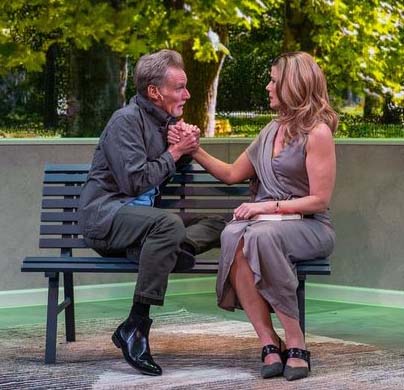
We first see the title character dressed in a medical gown, while his doctor tells him he will die in three months if he doesn’t stop drinking. Just then, he gets an international call, and suddenly he’s in a tux, delivering his acceptance speech for the Nobel Prize in literature. As performed with incredible stamina and masses of DGAF by Peter Bradbury, he’s a pompous know-it-all novelist in the mold of Norman Mailer or Philip Roth. In a gratingly loud voice, he delivers every utterance as if from on high, yet with enough humor and bravado to bend toward charisma. Unsurprisingly his personal life is a mess. He seems to have no friends, his wife committed suicide, and his son hates him, as does a former fling, whose extramarital affair provided the content of one of his best-sellers. “So I put real life into fiction,” he tells her, “that’s called art.”

He pontificates that surprise is the key to great art, and this play is full of unexpected turns and odd off-moments (as are the plays of Shakespeare, whom Akhtar cites as a major inspiration). Its setting in the literary world means that the characters are all hyper-articulate—which is a joy in itself to hear. Jeanne Paulsen, as McNeal’s agent, in her Manhattan black outfit and rockstar boots, is like his Lady Macbeth, scheming to win the New York Times profile and best-seller list on release of his latest novel, and later hushing up the fact that he used AI to create it. N’Jameh Camara does a star turn as the literary journalist assigned to interview him. He offends her from the start, asking if she’s a “diversity hire,” and bragging about his friendship with Harvey Weinstein. But she’s a cool fighter herself; their verbal thrust and parry is as thrilling to watch as a fencing match. She concludes the interview with the brutal “I’m glad that the world is getting rid of people like you and making room for people like me.”

All the performers are at the top of their game. As McNeal’s haunted, resentful son, Ty Fanning embodies Orestes, Oedipus, and Konstantin from The Sea Gull (among others) in their harrowing, violent confrontation. As “the younger woman,” with whom McNeal cheated on his wife, Bridget Ann White delivers both compassion and intelligence. In a scene that recalls Shakespeare’s most brilliant exchanges between the sexes, we can see her “doing the emotional work” on the fly, voicing, perhaps, what many women in her situation would wish they could say so precisely. Mark Clements’ sure-handed direction keeps the stage in dynamic movement, employing unconventional body language to vary the visual composition.
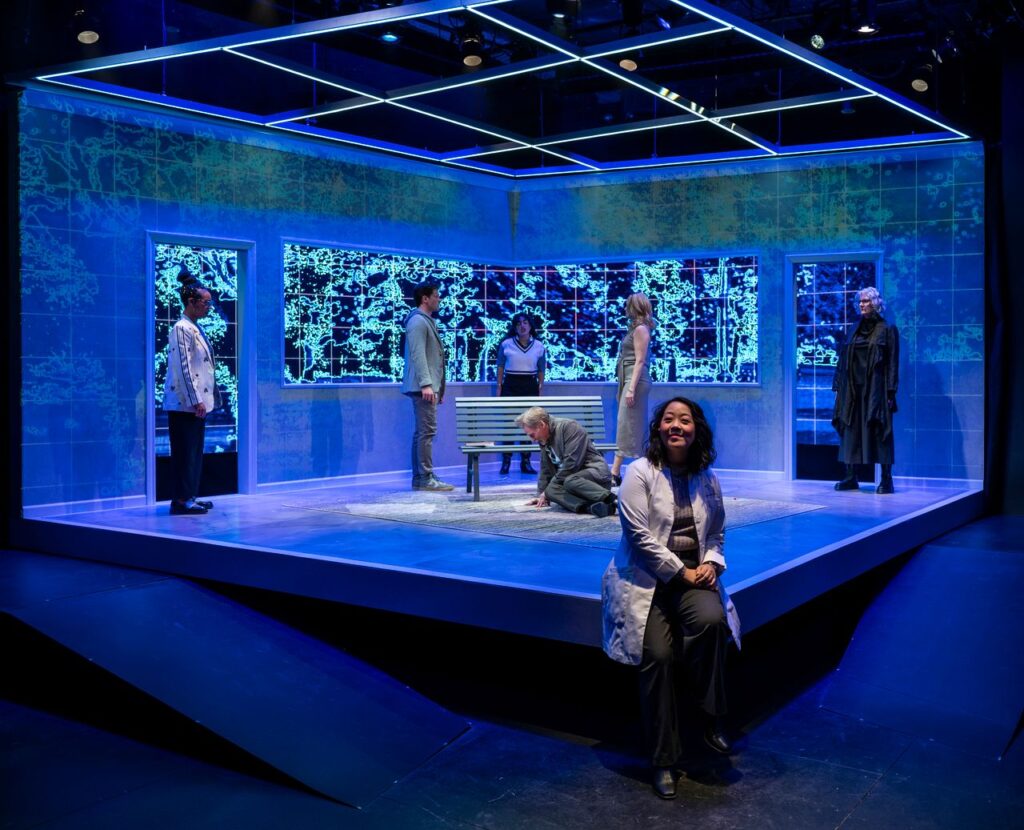
On of Aristotle’s six essential elements of tragedy is “spectacle,” and here the production overdelivers. The technical capacities of the Herro-Franke Studio Theater offer the design team a versatile, sophisticated instrument, which they play like Jimmy Hendrix on electric guitar. A motorized stage rotates Scenic Designer Emily Lotz’s brutalist set, teasing wall-sized projections of psychedelic graphics and digitally distorted scenery by Timothy Kelly that reinforce the show’s technological theme. Jason Fassl’s sensitive lighting and Dan Kazemi’s tone-perfect music subtly accent vibe shifts, and there’s a mind-bending tour-de-force pharmaceutical-induced hallucination sequence that recalls the scene in Richard III where the monarch is haunted by the ghosts of the people he’s wronged. It’s the dictionary definition of sublime, both grotesque and beautiful.
Ostensibly McNeal is about a famous writer who succumbs to the siren call of ChatGPT. But there’s a lot more going on in this Swiss watch of a play. Ideas and themes course through the performance, clashing like bucks butting horns. Akhtar doesn’t tell us what to think, but he raises so many questions, the play of thoughts in your head become another drama unfolding along with the one on stage. And the text evokes so much theater history, you can feel Shakespeare, Ibsen, Chekhov, Durrenmatt, even George Bernard Shaw, restively roaming behind the scenes. And then, midway through the play, we see a chatbot prompted to combine the works of as many famous writers and philosphers, along with other materials, into a novel “in the style of James McNeal,” and you begin to suspect that Akhtar generated it in AI himself (he says he didn’t— except for one crucial speech). Among the questions he raises are, in no particular order:
- Why does he choose a “great white man” type for his protagonist?
- Is McNeal a tragic figure? If so, what is his tragic flaw: the error that ultimately dooms him?
- What are those giant projected deepfakes of Ronald Reagan and…Barry Goldwater, I guess?… about? Hallucination? AI hallucination?
- When a voice came over the speakers saying “We are experiencing a technical difficulty, please remain in your seats” was that part of the play? It might have been!
- Why break the narrative by showing text of the dramatic structure of the final few acts, only to depart from it?
- What’s up with the final speech, a response to a very specific prompt? It’s the only part of the play that Akhtar said he made with the help of AI—and even then he only used two lines of it. And it’s perfect, bringing an unexpected up beat to an otherwise grim tale.
Many texts whisper to each other in this script, which was produced by a living author, or so we believe, doing work that now computer programs can also perform. Maybe the key text for McNeal is Christopher Marlowe’s Doctor Faustus. It’s easy to think of AI as a devil’s bargain: as Akhtar has said, the scariest part is that using it changes you. And yet, McNeal complains that his chatbots won’t give him the tragic story he desires. Instead they keep generating a textbook resolution.
Here’s another question: Is the tragic view of life something built into the “great white man” archetype in particular? Or is it a part of the general human condition, fear and loss manifesting as the cosmic mystery? Perhaps AI can’t understand tragedy because it’s not of the flesh as we are. In point of fact, it doesn’t understand anything, since meaning itself arises from the feelings of a living being. But whether an intelligent machine can feel or whether it can’t, it’s a terrifying prospect either way.
This deep, rich play is a feast for lovers of smart talk about art, and a fine inauguration for the Reps’ Studio Theater. It will be fun to see how the skilled artists of the Rep play with their wonderful new toy next time.
Milwaukee Rep presents
McNeal
by Ayad Akhtar
playing through March 22
https://www.milwaukeerep.com/shows/show/mcneal
WANT TO GET UPDATES EVERY TIME A NEW REVIEW IS POSTED?
Just send an email to:
playonmke@gmail.com
with the heading SUBSCRIBE ME
And you will be added to our contact list. Your contact information will be used for no other purpose than to give you reportage and analysis of the most cutting-edge, challenging, and inventive theater in Milwaukee!