Tag Archives: Wild Space

“Everything came alive”

photo by Mark Frohna

by Jeff Grygny

What does it mean to be alive? Something? Anything? If it means something, is it anything that we could say? In what language could we say it?

Wild Space Dance Company’s latest program, the epic Beyond the Shimmer offers strong evidence that it’s dance. The hour-long performance is a sprawling symphony of themes and variations in movement, with sparkling technical effects and enigmatic text projected on a giant screen. Ten dancers ebb and flow in a true ensemble, like particles in a cloud chamber, microbes on a slide, or galaxies and nebulas in the vastness of space/time: individuals weaving between the subjectivity and intersubjectivity of bodies. It’s a big dance, in scale and conception. As often with dance, there’s no story, characters, or conflicts to explain: it is what it is. Watching it is like staring at a Jackson Pollock painting until the splashes and squiggles seem to move, spelling wordless messages.
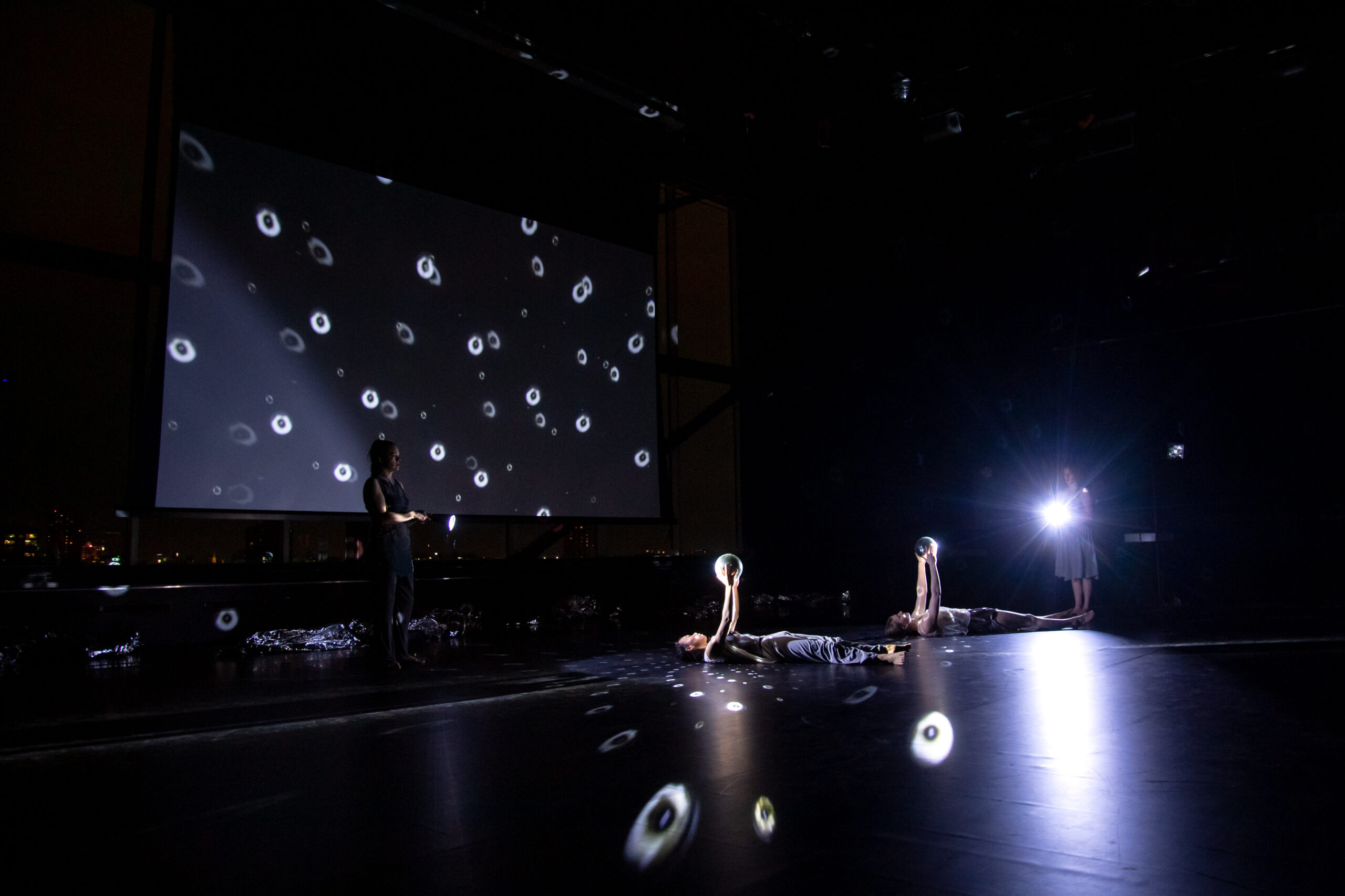
photo by Mark Frohna

The dance is choreographer and Wild Space Artistic Director Dan Schuchart’s reworking of a piece he made with UWM dance students several years back; one of the dancers in the show had even seen the dance performed by her younger siblings.

The dancers’ concentration is unwavering; their movements are precise, detailed, and fluid. The projected text by student Ambrose Shulte, now augmented by Brian Rott of Quasimondo Physical Theatre, varies from the very specific—memories of eating an orange; the history of the MIR space station—to clusters of open-ended third-person plural action words. The overall impression is of a universe of energetic verbs; individuals grouping and un-grouping, feeling separation, then merging like drops of mercury into shimmering communities, only to divide and splash outwards again, over and over. And while the idea of “space” comes up frequently, it’s not just the cold impersonal space of physics, but also the warm dynamic space of embodied “us-ness.”
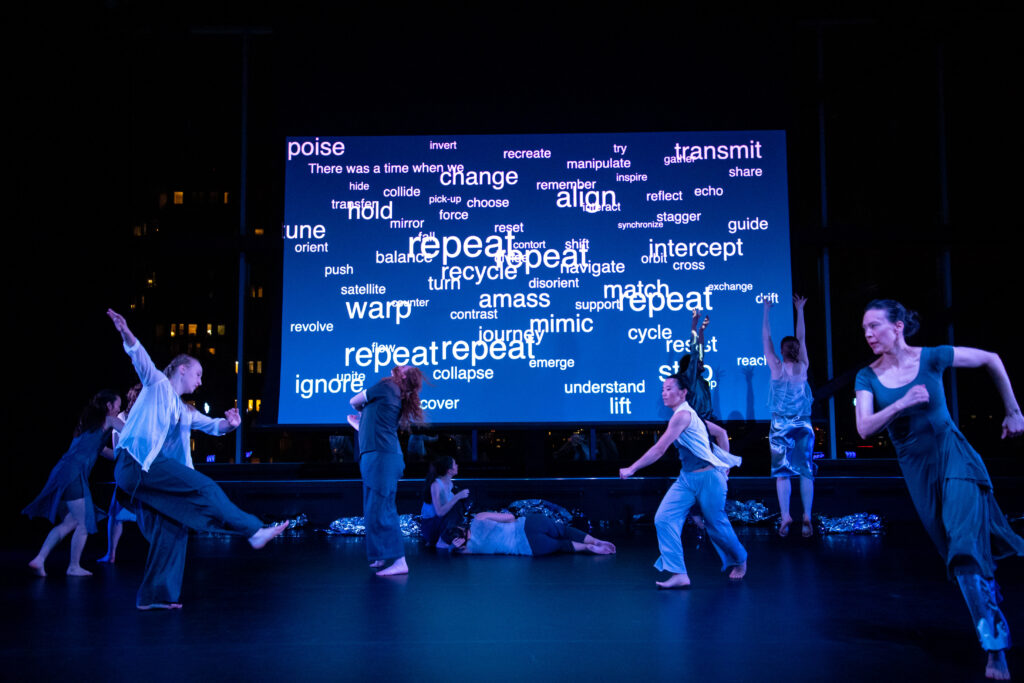
photo by Mark Frohna

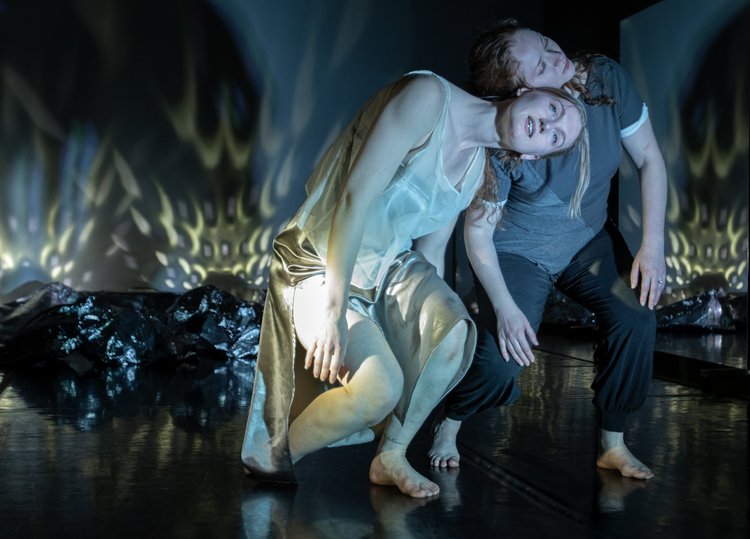
The color scheme is entirely grayscale: Kalyn Diercks’ costumes in shades of pearl, aluminum, smoke, and mist; black and white text; white light, mirror balls, and crinkly sheets of metallic mylar. The show treats technology as a toy and an art medium: matter animated by the human ludic impulse. The dancers play flashlights over the mirror balls, creating moire patterns in hypnotic shoals of moving dots. They drag the shiny material across the black floor, making silvery nests for supine figures, only to blow them away with a powerful industrial fan. In a spectacular finale, they release the sparkling film over the fan to fly 20 feet into the air, twisting like tornadoes or flapping like uncanny nebulas.
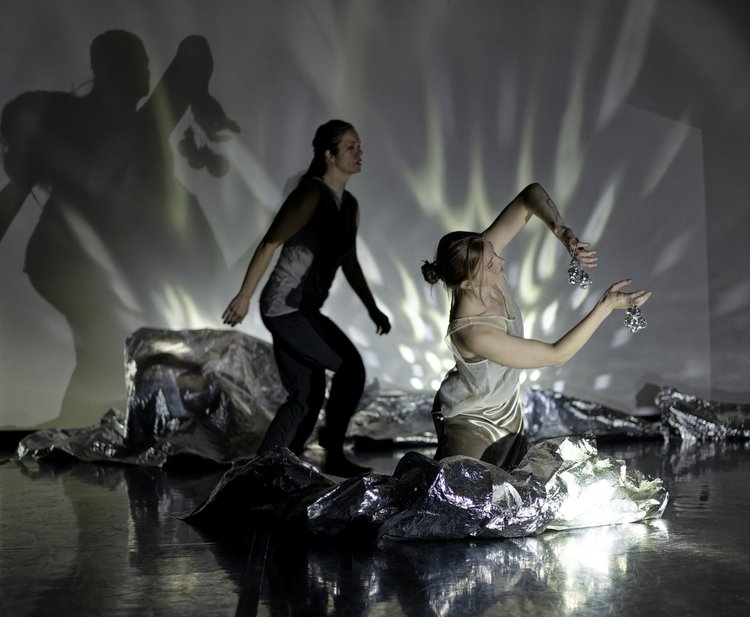
The evening began with a stunning solo by Schuchart entitled “Dan’s Wild Space” It was choreographed by guest artist Alexandria Barbier as the latest episode of the “few things ahead of time” series, in which a dancer and a choreographer create a composition in 48 hours, releasing inhibitions and liberates intuition to generate a sense of freshness and risk-taking that can leave you breathless.

It goes like this: Schuchart enters from behind the black curtains of the cleanly modern Jan Serr Studio. He measures himself against the two-story windows that spectacularly reveal the Milwaukee skyline. After a witty visual joke, and a brief exploration of the space, he walks downstage and asks “Am I standing too close?” The next sequence hews to ordinary movements, punctuated with brief spoken phrases that, free of context, are gnomic. They hint at a relationship that might become intimate? He sits on the floor facing the windows, The warm romantic tones of Sébastiene Tellier’s “La Ritournelle” begin to play and, like magic, the view of the city comes alive, lights in apartment windows, boats in the harbor, the flow of cars—and suddenly the city is an enchanted place, full of untold possibilities. Schuchart breaks into an uninhibited, heart-open dance; he lets his long hair down to fly freely, and as the vocals come up, he lip-syncs, smiling with pure joy:

Oh, nothing’s going to change my love for you
I wanna spend my life with you
So we make love on the grass under the moon
No one can tell, damned if I do
Forever journey on golden avenues
I drift in your eyes since I love you
I got that beat in my veins for only rule
Love is to share, mine is for you

The music fades; he ties up his hair and takes a well-deserved bow. It’s a delicious confluence of artists and space.

The meaning of dance is a right-brain thing; it’s almost impossible to articulate clearly, so dance is not a high priority for our militantly left-brain society. Beyond the Shimmer might be about the wonder and poignancy of consciousness as it emerges from space, coalescing in the play of vital, sentient flesh. Maybe that’s what all dance is about.

If any art form could claim the most immediate access to the meaning of life, it might be dance. And if any dance could communicate the sheer wonder of being alive, it might be Beyond the Shimmer.

Wild Space Dance Company presents

Beyond the Shimmer

April 10-11, 2026

https://www.wildspacedance.org/shimmerprogram

WANT TO GET UPDATES EVERY TIME A NEW REVIEW IS POSTED?
Just send an email to:

playonmke@gmail.com

with the heading SUBSCRIBE ME

And you will be added to our contact list. Your contact information will be used for no other purpose than to give you reportage and analysis of the most cutting-edge, challenging, and inventive theater in Milwaukee!

EARTH ART MAGIC

photos by Jeff Grygny

by Jeff Grygny

You’re walking down a torchlit path with people you don’t know. The night clouds glow with reflected urban light. You notice odd sounds coming from the darkness to your left: shadowy figures, neither human nor animal, are tracking your course, their bulky shapes bristling with long, fan-like spikes. Where the paths cross, a man in red is praying–or is he having a seizure? He mutters, twisting and bending with jerking movements. You start to lose track of what real: that rhythmic sound in the tree—is it a cicada? Or a hidden speaker? That sound—is it the wind rustling the leaves? Or is it part of the ethereal sonic atmospheres created by a woman sitting on the ground by the side of the path, moving her hands over some instrument? A woman in blue emerges into the light; the man and his red-clad cohorts step back; they sway as she dances alone, sadly and slowly. At last the man and the woman both leave, going down different paths.

Is this a dream? A hallucination? It can be hard to tell sometimes during Field Guide, the latest in Wild Space Dance Company’s In Site series of works created for specific places, in this case, Havenwoods State Forest, the only state forest within the City of Milwaukee. This enchanting immersive performance takes the audience from place to ingeniously-lit place within the park, and under the steady direction of Artistic Director Dan Schuchart, it’s a tour-de-force of creative, technical, and logistic imagination: the most daring and original adventure in the performing arts our city has seen in years. And like all good art, it stirs up many thoughts. feelings and senses, which will not necessarily be the same for any two people.

This magical work is produced in collaboration with Ometochtli Mexican Folk Dance company and musicians from the Out There performance group, which organizes outdoor avant garde concerts. It’s an impressive bringing together of different cultural traditions and artistic vocabularies that somehow, magically, creates something exceptionally moving and powerful.  Throughout it all. the night time woods and prairie provide not only a fantastic setting for the dances, but are also full of numinous presences that are palpable, if not always visible, characters in their own right.

The evening opens with a grand demonstration of this alchemy: the Wild-Space dancers enter a wide open field, running, interacting, mirroring and varying each other’s movements. They approach the audience and speak about things they have encountered on the land, not by naming them, but with poetry that melts into movement. Then, women of Ometochtli enter in traditional garb, carrying ribbons of different colors which they skillfully weave into kaleidoscopic patterns, which is apparently an art that goes back to pre-colonial times. The two groups move among and around each other, weaving the modern and the traditional in ways that express their humanity while holding the integrity of their own cultural languages. It’s beautiful  to see—and incredibly moving.

The audience divides into two groups, each following a guide with a luminous baton along winding trails and into different prepared performance spaces. I don’t know if both groups see all of the performances: our group could hear the drumming and cries of Ometochtli as we moved between sites. But we did witness other visions: dancers suspended from an ancient tree by ropes, launching themselves airborne and dancing on the tree’s trunk as if it were the ground; and then a palate-cleansing interlude involving sand and changing spatial and emotional relationships, to live violin accompaniment. On our way to the final act we were met with the sweet fragrance of burning copal wood, and the forceful drumming and conch-trumpets of a procession by the dancers of Ometochtli, coming to meet us in full regalia of spangles, feathers, and ankle-bells. It was an unforgettable dramatic moment in an evening of surprises—and surprise, after all, is one of the indispensable qualities of great art.

The conclusion was a traditional Aztec ceremony blessing the six directions: East, South, West, North, Above, and Below. To say that in no way captures the visceral impact of the ritual. As a modern observer, one might experience a web of complicated feelings: a sense of touristic consumerism, perhaps, as we raise our cameraphones to record the spectacle; a sense of enormous gratitude to the dancers of Ometochtli for sharing their precious cultural heritage; an uncanny disconnect between modern dance, with its deep orientation to individual experience, and the traditional dance, which honors community and continuity; a sense of wonder at the harmonious interplay of the two; sorrow, anger, and fear for the people who are even today being ripped from their homes and families by a cruel administrative machine; and a sense of awe, as the customs of a distant land bless and empower the land beneath our very feet, land that has been inhabited by a different indigenous people, then colonized, farmed, turned into a prison, then a base for fearsome weapons, and now restored to a semblance of the natural world.

We modern people, by default, see nature as scenery, a pretty luxury getaway, or even as an inconvenience. For every other culture in the human story, the natural world is a society of beings, on whom we depend for our very lives. The traditional view is closer to the truth, of course: the founding ecologist Aldo Leopold wrote  that we should not see the land as something that we own, but rather as a community that we are part of. It may be that our future depends on becoming more like indigenous people—not by imitating their lifeways, but by exploring cultural practices that transform the impersonal, exploitive relationship with the living world that we inherited from the materialist culture we grew up in.Wild Space gives us a brilliant picture of how this can happen.

Ecological scholar Roy Scranton has written that “ …the narratives and meanings we associate with the natural world are never simply given nor inherent, waiting to be revealed . . . [They] are cultural, taught, passed down from one generation to the next, revised to accommodate new evidence, molded to serve political needs, and warped by social currents and mass emotions, all the while evolving through their own poorly understood dynamics and trajectories.” Which is to say, our relationship with the living world is permeable to needs and influences, even deliberate intervention, using the instruments of cultural transmission, like education, advocacy— and the arts!

As events beyond out power thrust us into an uncertain future, socially, technologically, and ecologically, creative, cultural exchanges and cross-pollination like this Wild Space performance are priceless models for how to per-form a new culture for our children and their children’s children. In this way, Field Guide is a luminous signal, guiding us through our modern wilderness towards a more harmonious way of human life on Earth.

Wild Space

in collaboration with Ometochtli Mexican Folk Dance

presents

InSite: Field Guide

October 10 and 11, 2025

Choreography by:

Katelyn Altmann, Cuauhtli Ramírez Castro, Ash Ernesto, Zoe Mei Glise, Alejandra Jiménez, Elisabeth Roskopf, Dan Schuchart, and in collaboration with the dancers

Music Direction and Live Performance by:

Lorna Dune, John Larkin, Allen Russell, Antonio Velázquez

Lighting Design & Stage Manager:

Colin Gawronski

Technical Director:

Tony Lyons

Tech Crew & Docents:

Maria Shanklin, Rae Zimmerli

PERFORMERS:

Ometochtli: Favi Álvarez, Leah Colchado, Ash Ernesto, Angelica Escamilla, Norma Gonzalez, Alejandra Jiménez, Mariela Jiménez, Laura Medina, Jaquelin Moreno, María Pérez, Yarely Ramírez, Alejandra Rodríguez Ortega, Antonio Velázquez

Wild Space: Katelyn Altmann, Emma Becker, Audrey Dudek, Angela Frederick, Cuauhtli Ramírez Castro, Ashley Ray Garcia, Zoe Mei Glise, Jessica Lueck, Jenni Reinke, Elisabeth Roskopf, Nicole Spence, Jasmine Uras

Want to get updates every time a new review is posted? Just send an email to:

playonmke@gmail.com

with the heading SUBSCRIBE ME

And you will be added to our contact list. Your contact information will be used for no other purpose than to give you reportage and analysis of the most cutting-edge, challenging, and inventive theater in Milwaukee!

Looking closely helps: Wild Space performs “Under the Freeway”

photo by Mark Frohna

by Jeff Grygny

For those of us addicted to live performance, this has been a season of withdrawal. No matter how lovingly produced virtual theater might be, the flat screen just can’t equal the warm, breathing in-person event. So it was that, driven by a certain thirst, we recently had an entirely new experience: watching a dance concert through a car windshield (I recommend the shotgun seat for the most unobstructed view).

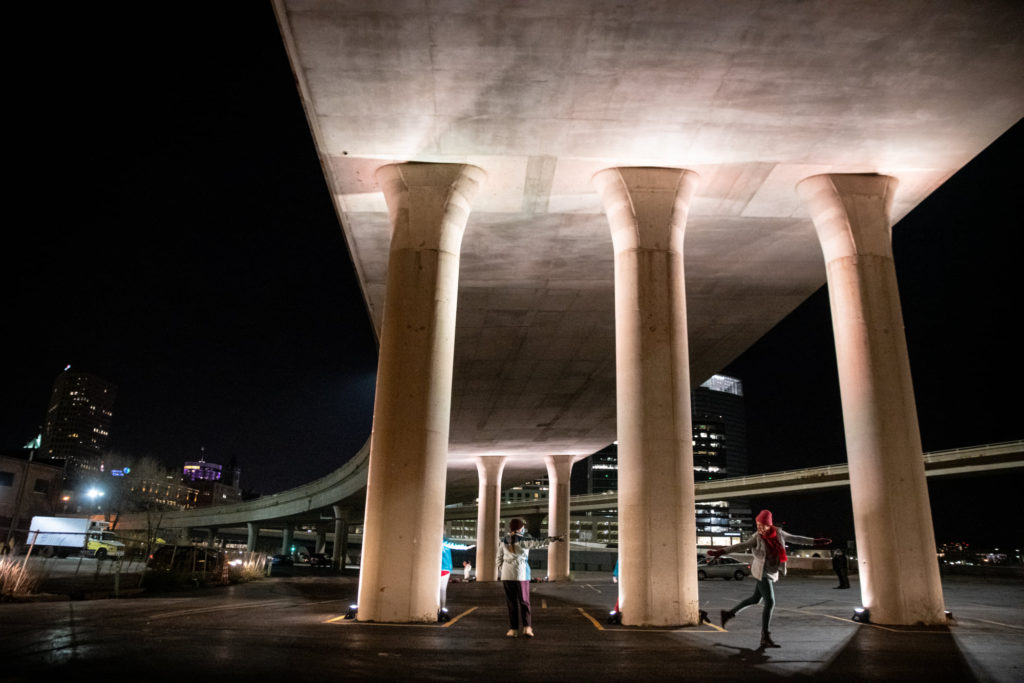
Long accustomed to on-site performance, Debra Loewen’s Wild Space Dance Company has been one of the few groups in town to brave the outdoors and organize dances in parking lots The third of such offerings,  “Under the Freeway,” played last week for several performances. The very circumstances of the event dictated their own form and drama, and even created a role for the audience: we herded our cars into specific configurations under the on-ramp to the Hoan bridge, marshaled by baton-wielding dancers, like an alien ritual in which two-legged masked beings command giant metal and glass wheeled creatures.

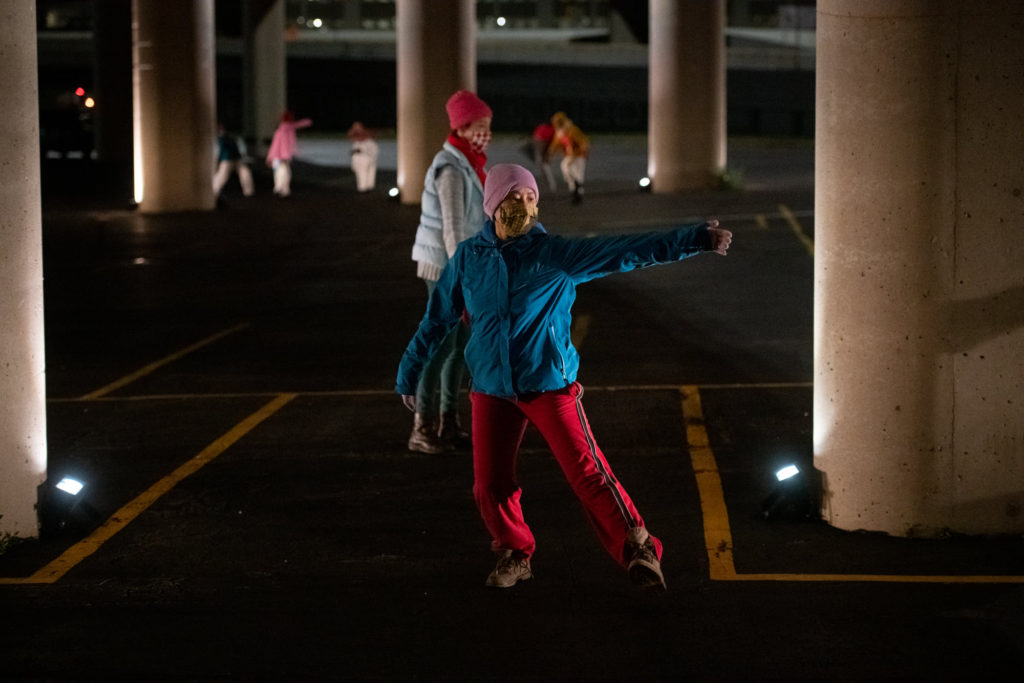
Illuminated by the bright eye-beams of docile vehicles, two groups of dancers, some thirty yards apart from each other, performed 20-minute routines under the soaring concrete columns, accompanied by soundtracks that had been downloaded and played on personal phones. No two cars could witness exactly the same show. Then the cars were deftly shepherded to change positions, and we saw the same choreography from the opposite side.

photo by Mark Frohna

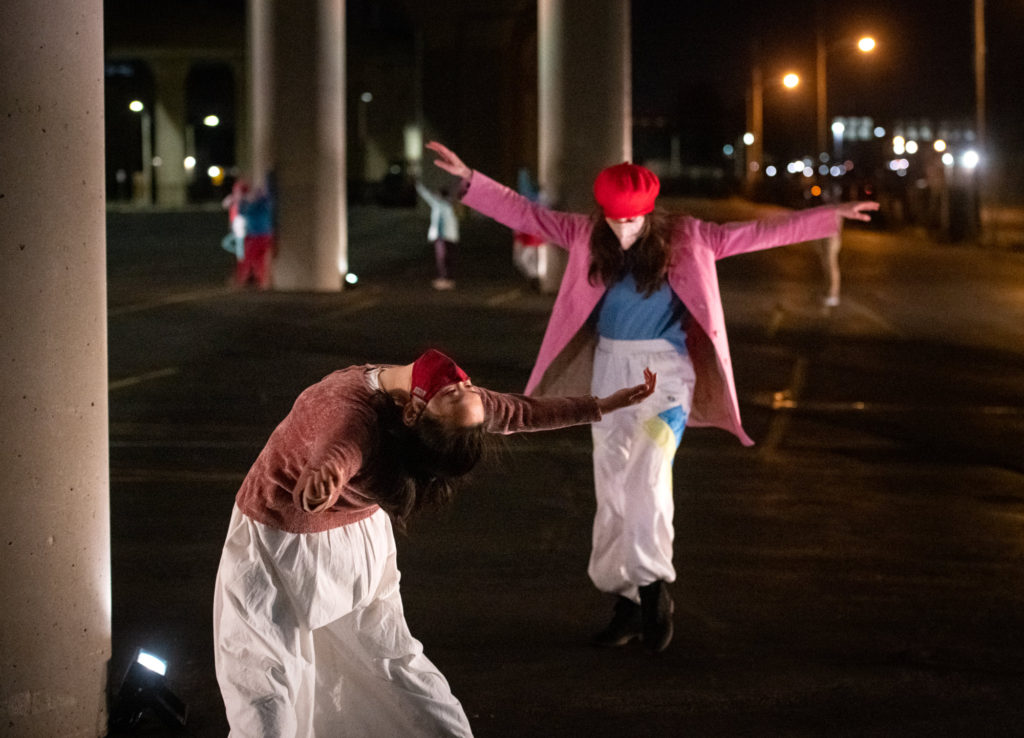
The company’s signature movement style is abstract and body-based, introducing motifs and variations that seem to have been been born out of the dancer’s personal impulses. As the dances develop, we appreciate space, form, tension, contrast, and coordinated movement. From behind your glass shield, you can see one group performing quite close, even occasionally peering at you, and at the same time see the other group as tiny figures in the distance. What is hidden on the first viewing is revealed in the second, and vice versa; your experience accumulates richness as the evening progresses.

photo by Mark Frohna

The scores are eclectic collages of modern, classical, and tango fragments, snatches of spoken word,  musique concrete and passages of silence. At one point a voice quotes avant-garde chance composer John Cage: “Looking closely helps.” Indeed, this style gives the viewer great freedom (and responsibility) for their focus. Whatever theme or narrative there is, the viewer must construct herself. It seemed that the southern performance group had a cool, alienated mood, while the northern side seemed warmer and more communal—aided, no doubt, by the energetic Alisha Jihn, who dances like a burning torch. At the end, as we feebly applauded inside our machines, then followed the leader out of the lot and back into the streets, the performance felt like a perfect microcosm of the strange situation our world is in: brave souls cavorting in bright white light while traffic rolls a hundred feet above, and we huddle in our mobile shells, cut off from community, but sheltering its warmth like a candle being carried across a huge dark room.

The artists of Wild Space are keeping  the flame lit, until such a night comes when we can once again gather around the fire, unmasked.

Parking Lot Performance #3 “Under the Freeway”

by Wild Space Dance Company

Debra Loewen, Artistic Director

Dancers: Ben Follensbee, Alisha Jihn, Molly Kiefer, Jackie Kostichka, Nekea Leon, Molly Mingey, Emily Olson, Jenni Reinke, Yeng Vang-Strath