
by Jeff Grygny
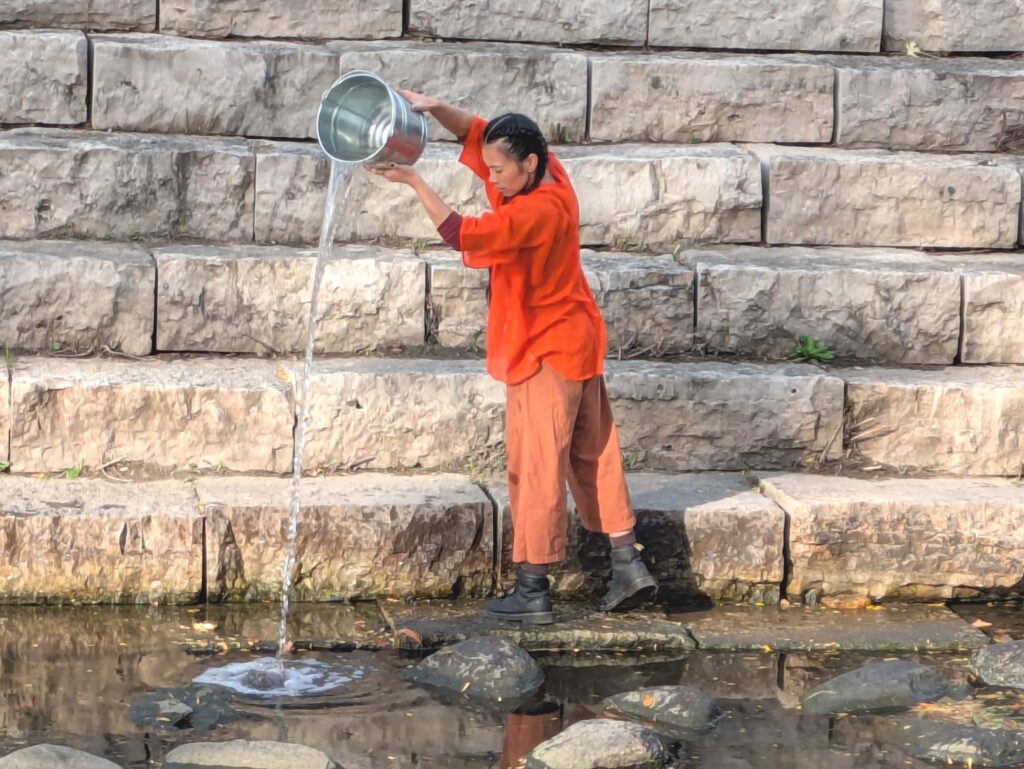
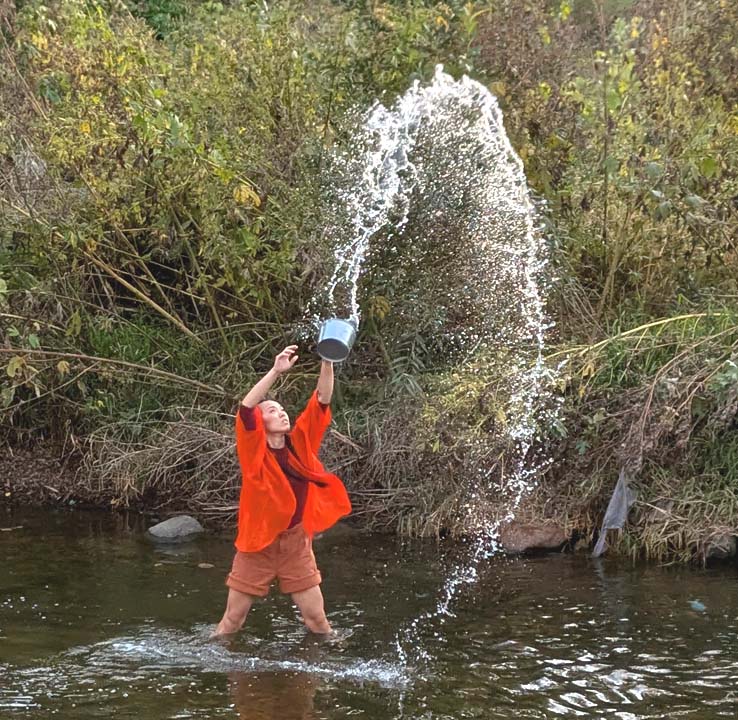
There’s a certain dramatic tension latent in a bucket of water. Water is fascinating, and the act of tilting the container; the emergence of liquid like a living thing, forming itself into an arc foreordained by the laws of motion, an evanescent shape in the air, and then pouring out to its foreordained yet satisfying finish — it’s a tiny self-enclosed story.
This little story opens and closes the performance of InSite: En Route, the latest site-specific production by Wild Space Dance Company. Artistic Director Dan Schuchart has shaped an experience of art and nature that unfolds into elegant vistas and hermetic nooks of meaning which, on a gorgeous Autumn afternoon, leaves the spectator in a grateful state of sublime bliss.
Wild Space has been making dance with the same recipe since it’s founding by the visionary Deb Loewen forty years ago: find a place that stimulates imagination; explore movements and gestures that play in that space; reveal the visions it generates. In his four years as Loewen’s successor, Schuchart has proven that the form still generates excitement, with his mastery of selecting a specific palette of colors and objects and then exploring their potential for resonance, spectacle, and drama.
Schuchart has assembled a group of artists whose work reflects and illuminates the cultures of the Pulaski Park neighborhood. As a prelude, local activist Esperanza Gutierrez. who helped create the KK River Neighbors In Action, lent context to the performances with her decades of lived history near this little stretch of water: how it was a concrete flood channel; how children and unhoused people lost their lives in unpredictable, violent currents, and how neighbors organized to remove part of the concrete and restore the river to a more ecologically rich and human-friendly condition.
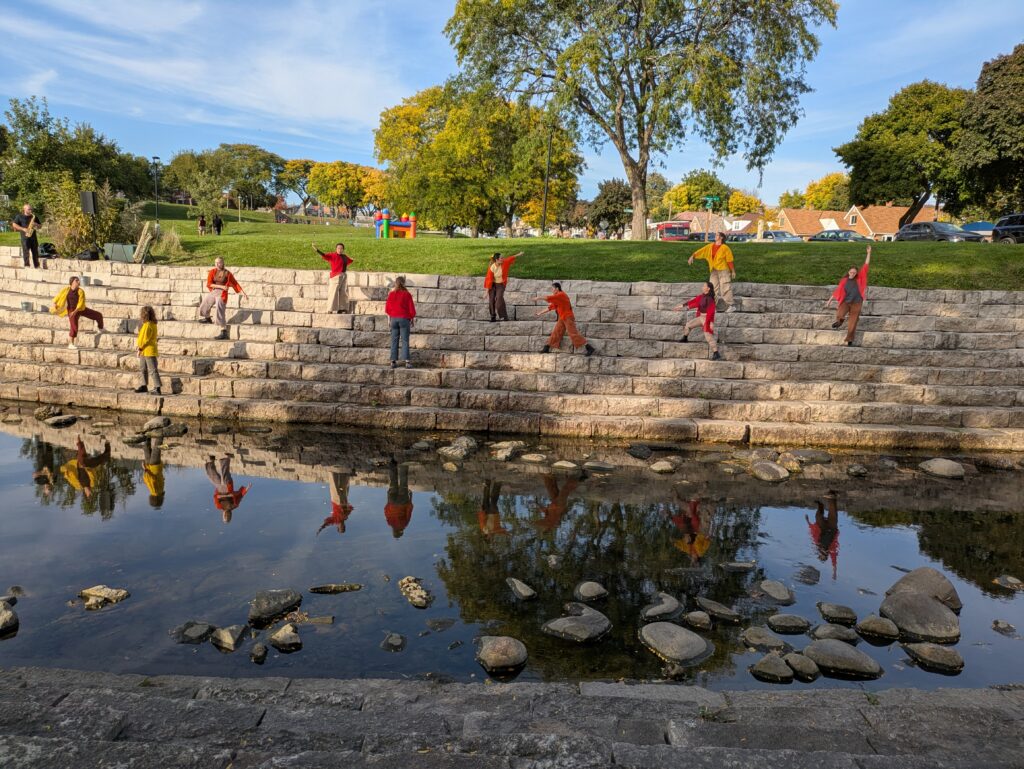
The results of their work is here for all to see: on this Saturday, Pulaski Park glows like a Platonic ideal of a neighborhood park: the river wending gently through a curving channel lined with greenery, diverse youths shoot baskets and goof around, children zoom by on bikes, all under a benevolent cerulean heaven.
The dancers emerge from under the 17th Avenue bridge, galvanized buckets in hand, disporting themselves on the stone-stepped banks like animated hieroglyphic figures. They contemplatively dip their vessels into the water and mindfully pour it back in graceful rivulets, tiny re-enactments of both the earths’ water cycles and the human labor of restoration. They are accompanied by the elemental tones of Nick Zoulek’s saxophone, playing a Philip Glass-like series of repetitions and variations. The program states that Zoulek achieves his sound through “a tapestry of circular breathing, extended overtones, vocalizations, and unrelenting arpeggios.”
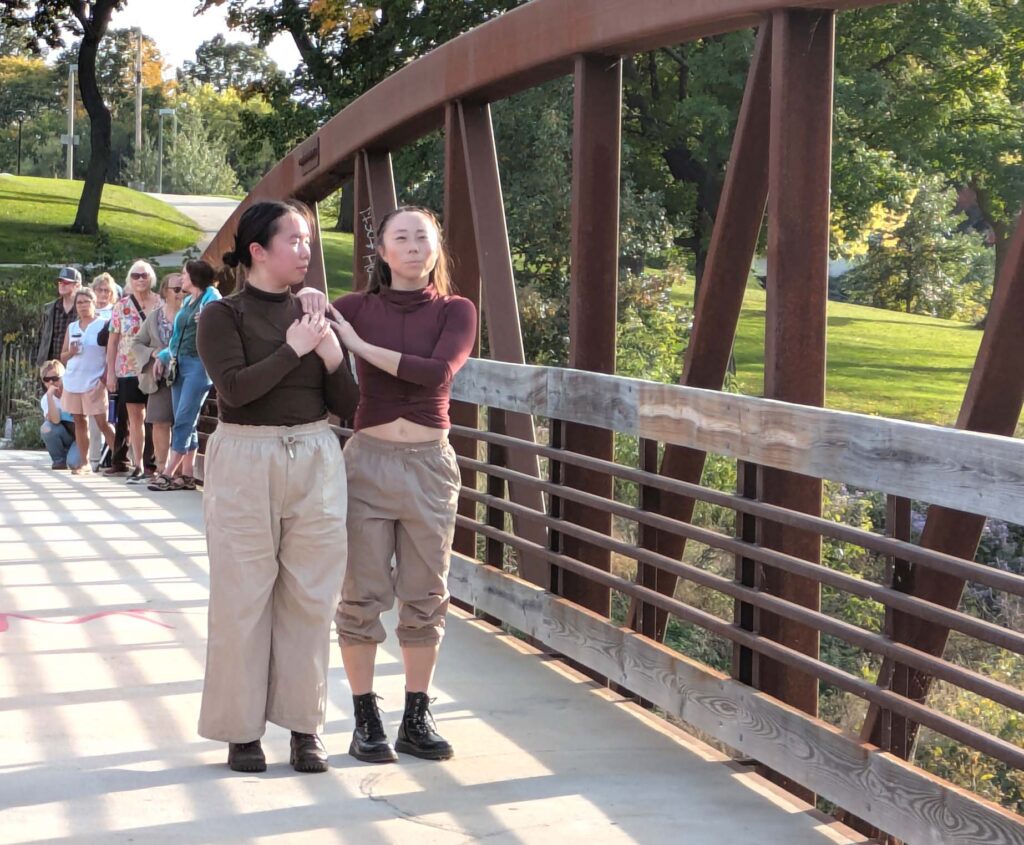
The audience is invited to split into two groups, each moving in opposite directions but witnessing the same performances, which enter into the human world with a trio of performances: a sweet folksy duet about two women discovering connection through black roses, choreographed by Sabrina Lina Conchi of Ballet Folklórico Xanharati (“Black flowers,” she writes in her program note, “are rare to find— they grow their roots deep into Mother Earth. Our threads cross and intertwine, until we are able to pull them apart and share them with the one full of worth.”). There’s an extremely laid-back presentation on a basketball court by Andrea Chastant Burkholder and the Milwaukee Rhythm Skaters, and a dance by Korean American Dance Artist Elisabeth Roskopf, in which two women discover connection on a footbridge, in “a space where identity is not rooted in a fixed origin, but one that holds a multiplicity of places and personal histories that live within them.” Close by, vagrant dragonflies flash their cellophane wings, while ducks preen on the rocks below.
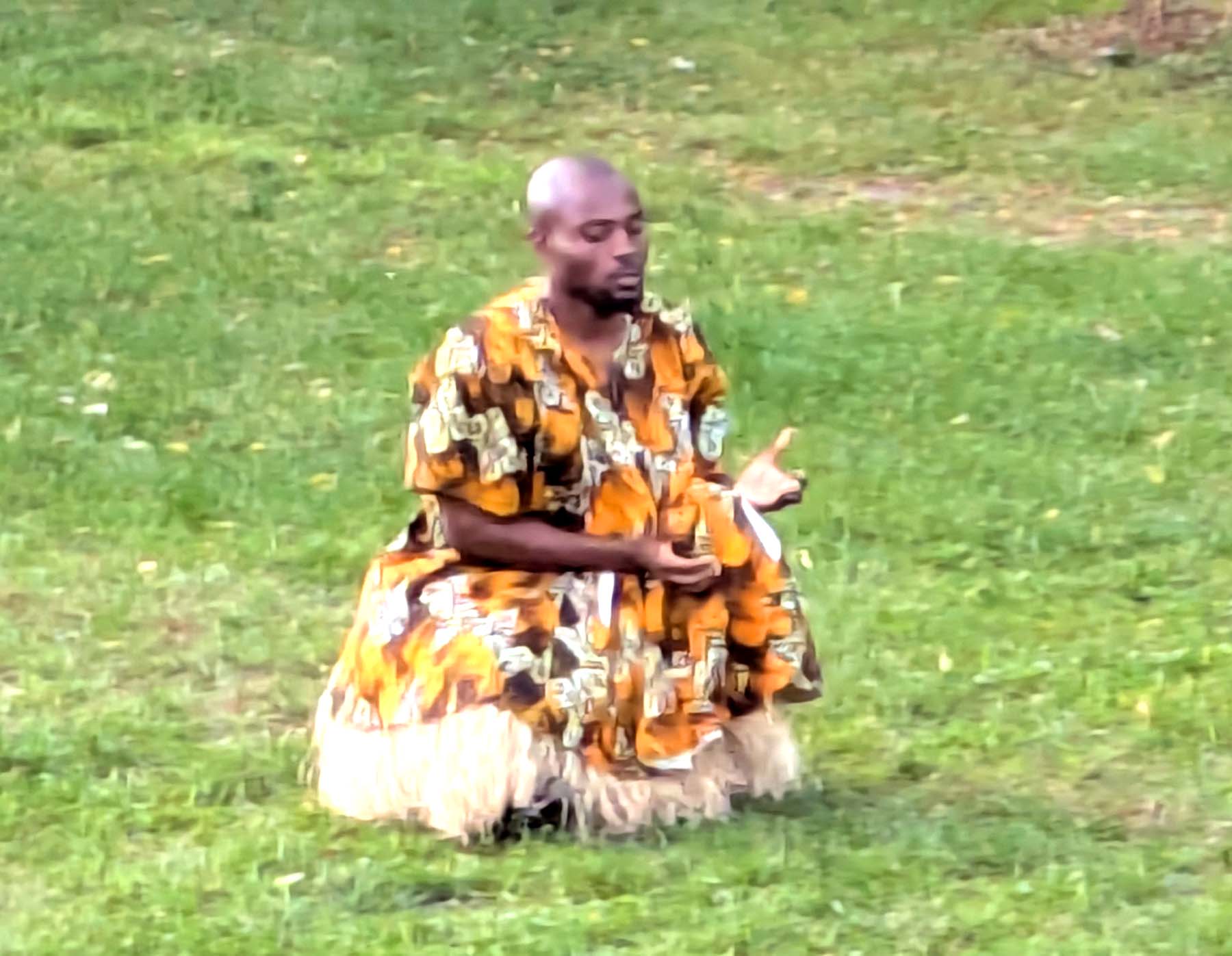
It seems like, when performance ventures into the natural world, it heightens our attention to both, and brings both to richer life. Certainly the white butterflies seemed to tease the margins of Ishmael Konney’s powerful riverbank solo. To the rich, warm strains of Okaidja Afroso’s song “Àtsii Nū Náá,” Konney enters, resembling an African shaman: wide grass skirt, colorful top, metal bells strapped on his legs. The song’s lyrics say “one is not supposed to interfere/block water;” the dance invokes both the land and the lives lost in flooding, including the recent floods in Konney’s Ghanaian homeland: a heartfelt prayer in movement.
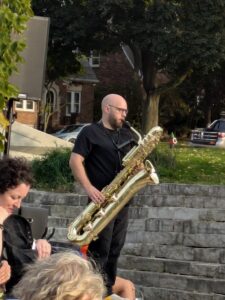
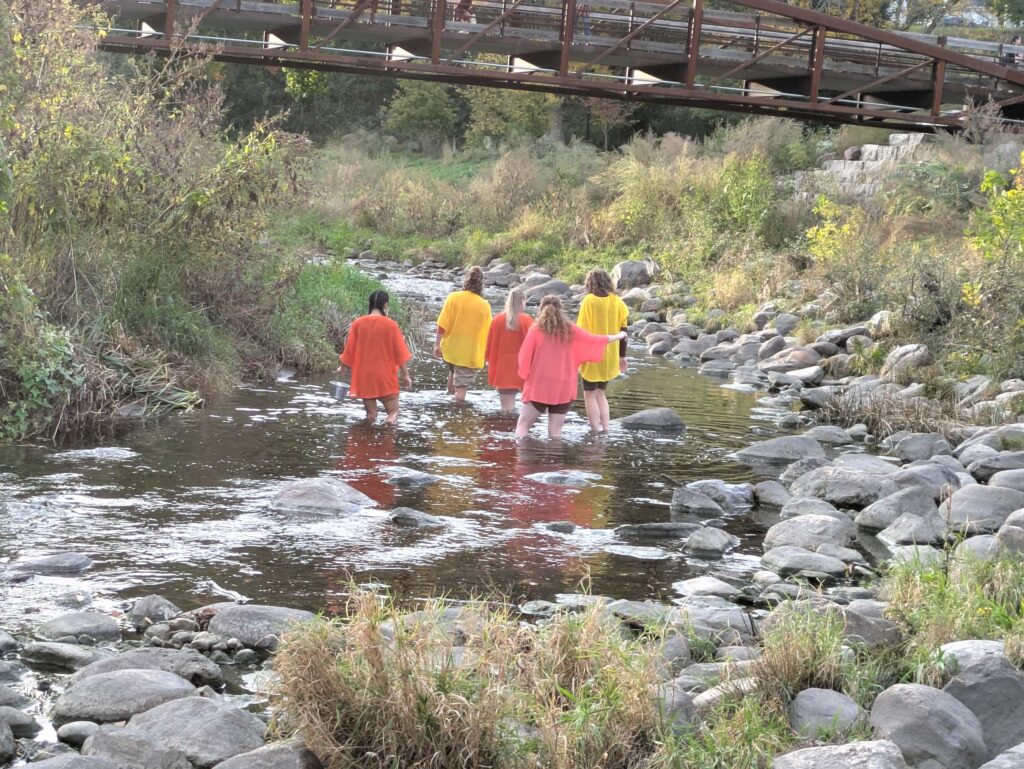
The finale takes us back to the river, where Zoulek emits otherworldly sounds from the most enormous saxophone I’ve ever seen, while dancers wade downstream, going with the flow, their feet clad in nonskid booties, tossing their bucket’s aqueous contents in great arcs of sparkling drops. The duck family moves warily away as the dancers wend their way under the footbridge; one duck takes wing as they slowly approach a turn in the river, into the sunset, on a journey, and the performance closes in a simple yet spectacularly perfect coup de theatre.
Breathless, we gather ourselves to make our own journeys.
Wild Space Dance Company presents
InSite: En Route
October 9- 10