

Karma’s a relaxing thought
Aren’t you envious that for you it’s not?
Sweet like honey, karma is a cat
Purring in my lap ’cause it loves me
Flexing like a goddamn acrobat
Me and karma vibe like that
Taylor Swift
by Jeff Grygny
Suppose you’re an eminent man, a wealthy benefactor respected in your community. Isn’t it only natural to alleycat around a bit? After all, what are pretty girls if not one of the perks of power?
Thus is planted the seeds of the interwoven tragedies in Henrik Ibsen’s Ghosts, now playing in a sturdy production by Wisconsin Classic Stage. Ibsen is revered as one of the great playwrights of the Nineteenth Century; George Bernard Shaw regarded him as better than Shakespeare (of course, Shaw despised Shakespeare).
But when Ghosts (or in Norwegian, Gengangere, literally “the ones who return”) first played for a single private performance in London, it provoked outrage: “It is a wretched, deplorable, loathsome history,” one critic wrote, adding that the play was “revoltingly suggestive and blasphemous,” and “a dirty deed done in public”. Society at large wasn’t ready for the infidelity, incest, and venereal disease that the story turns on. The first printed scripts incurred so much ire that booksellers removed them from their shelves.
What is it that rouses such admiration and condemnation? We notice that the scandalous deeds never actually appear, nor are really even discussed, on stage: they are only communicated in hints and allusions. Still, it was a play that Ibsen said he had to write.
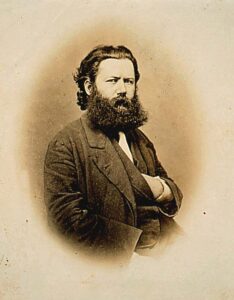
Ibsen pioneered the new literary style of realism, which, in the wake of the previous century’s scientific and social revolutions, abandoned the poetic tropes of earlier times for the bracing, raw, hard truth. He created a new kind of character, whose soul is hidden even from themselves, revealed only obliquely, almost accidentally. (Ghosts was published in 1881, fourteen years before Sigmund Freud published his Studies on Hysteria which established a radical new understanding of human motivations.)
But Ibsen’s chief goal was to expose the hypocrisy of upper class society: how the rigid Lutheran morality of his native Norway locked people, especially women, in cages of joyless, stifling propriety — as his later plays Hedda Gabler and A Doll’s House attest. And in the days before MeToo, it was easy for powerful men to treat young women as property without consequence.
Joshua Pohja, the play’s director, has chosen to stage this drama of whispers and secrets outdoors, in a cul-de-sac behind Calvary Presbyterian Church. In keeping with the realistic style, the production team has assembled a passable 19th century bourgeois living room in this “parking lot.” They’ve even managed to create a simulacrum of rain with an ingenious arrangement of pipes.
Pohja has coached the players reveal their character’s reactions with expressive body language. He keeps the stage picture in motion, adding to the sense of restless tension — though the overall pace might benefit from a more tactical use of dramatic pauses.
Now, suppose you’re an elderly widower. Wouldn’t it be natural to expect your unmarried daughter, who serves as a maid for a wealthy family, to move back home to ease your loneliness and entertain your guests? But what if she has her hopes set on the dashing young artist who has recently moved back home from Paris, even if he does drink rather a lot?

In the role of Regina, the daughter, Ashley Garcia embodies the “spark of life” that the other characters yearn for. And, in a play where almost everyone talks like a Nineteenth Century book, she delivers her lines most conversationally to contemporary ears. As her adoptive father, the fast-talking rascal Engstrand, Ryan Holifeld brings a welcome splash of comedic energy to the overall gloomy proceedings.
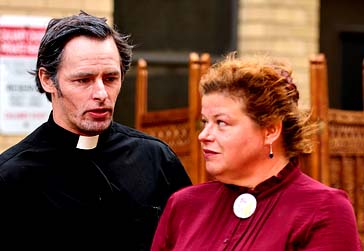
Deborah Stencel plays Helene, the late Captain Alving’s widow, with upper-class poise that gradually transforms through denial into agony, as revelations of the truth batter down the walls of her years of pretense. Cole Castine, as her advisor, the local pastor, brings more charisma than is generally expected from a Lutheran minister; through him, we witness a man seeing his life’s certainties gradually going up in flames.

While, as the doomed artist Oswald Alving, who, like Orestes, suffers for the crimes of others, Ben Skwierawski (accompanied by his epic bohemian hairstyle) runs a grueling gamut of psychological states, from valiant pretense to utter collapse. You can almost hear the playwright’s voice when Oswald defends the artistic lifestyle against the disapproving cleric.
But it’s Regina who might be the real protagonist of the story. When she learns that she’s an illegitimate child, she’s understandably irate that she was made a servant rather than brought up a rich girl. And like Nora in A Dolls House, she gets out of the play with her agency intact.

In times like ours, when powerful men still evade the consequences of their sexual crimes, and while political forces are working energetically to re-establish a state dominated by religion and “traditional values,” it’s worth paying heed to a message from earlier days: if their morality seems too pure to actually live by, it probably is. Karma will eventually have it’s way.
On the other hand, there is also a strain in our culture — descended from Ibsen, really — that seems to believe that only darkness is true; that every pretty picture covers over a rotten underside. We surely do tempt karma by denying the dark side of the truth. But is there yet a place in our hyper-realistic world for the infinite shades and hues of poetry?
I think there must be.
Wisconsin Classic Stage presents
Ghosts
by Henrik Ibsen
playing through July 19, 2026