
by Jeff Grygny
Back in the 60’s and 70s — peak years for experimental theater — observers of work by such artists as the visionary Jerzy Grotowski, the scandalous Living Theatre, and the ruthlessly cerebral Richard Foreman, noted a phenomenon they called “the avant-garde smile.” It’s the self-satisfied smirk of one who knows the secret code; not a mere bourgeois baffled by some weird performance. It’s virtually extinct these days: decimated by the twin beasts of commercial entertainment and social realism.
So it’s nice to see a genuinely avant-garde production in Milwaukee, even if it is a play that’s nearly a century old. Doctor Faustus Lights the Lights, written by Gertrude Stein back in 1938 and currently playing in an ambitious, joyous interpretation by Wisconsin Classic Stage, still has the power to baffle. If something like a metaphysical opera directed by Ken Russell and costumed by Lady Gaga, with a libretto by a very stoned Doctor Seuss appeals to you, you should rush out and see this show.
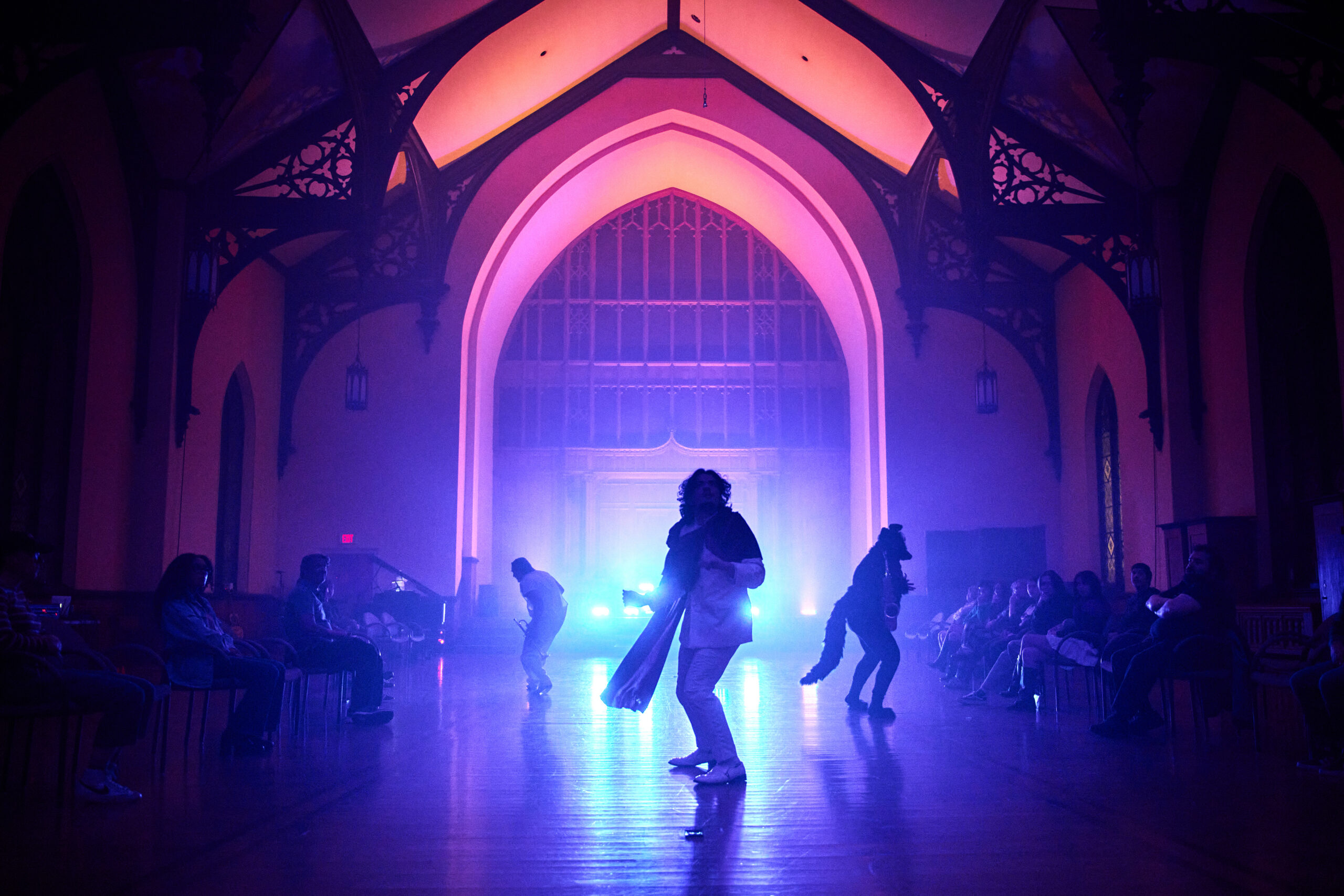
Director Cole Castine has created a full-concept work of total theater: scenery costume, lighting, music, movement, music, and text all work together to create a spectacular experience in the cavernous space of Calvary Presbyterian Church: an appropriate setting for a play about damnation…and maybe salvation? Or something? It’s hard to say exactly what the show is about.
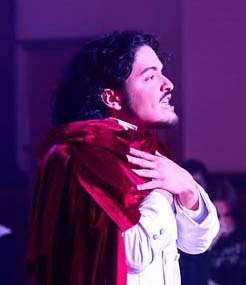
Stein was more concerned with the sounds of language than its literal meaning. She treats words as music, twisting them in recursive variations like a Bach fugue. Her version of the Faust legend casts the Doctor as a scientist and inventor, creator of the electric light, which transformed the world — and who is (like certain other technological innovators we might name) a bit of an ass. Antonio J. Parra plays him as a grandiose, if charismatic, pedant, talk-singing his moebius-like pronouncements like a prima donna delivering an aria.
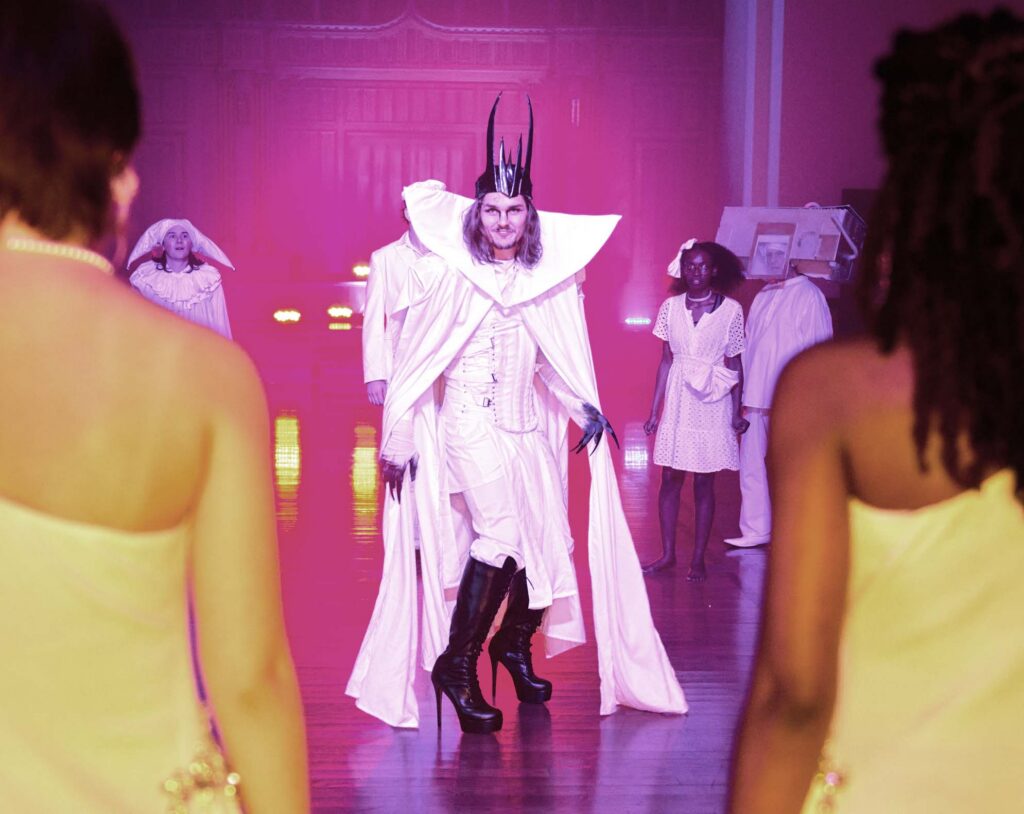
Mephisto, his supernatural handler, is rendered as a menacing androgynous figure by Evan Smolik, statuesque and lurching around in platform heels that recall the devil’s cloven hooves, his digitally-enhanced voice spookily broadcast through the house speakers. He plays a relatively small part in the action, though; more central is the confusingly (and very frequently) named “Marguerite Ida & Helena Annabel,” who is portrayed by two charming actresses, Dylana Bauduin and Esther Akinsanya (though she is always referred to as if she were one person with two names and an ampersand). “Marguerite” is the name of Faust’s love interest in Goethe’s version of the tale, but her/their role here is less defined. She/they is bitten (or is it stung?) by a viper, given as a silvery length of HVAC pipe.
With a coterie of other characters, dressed in Tianna Lee’s all-white, highly-structured costumes that resemble Commedia Del’Arte figures as conceived by Bauhaus designers, she/they entreat Faustus to cure her/them—which he does…sort of? A “Man from Over The Seas,” played with debonair panache by Tyler Stauffacher, makes a classic do-wop entrance, singing a courtship song, but it’s unclear whether she/they reciprocates or not.
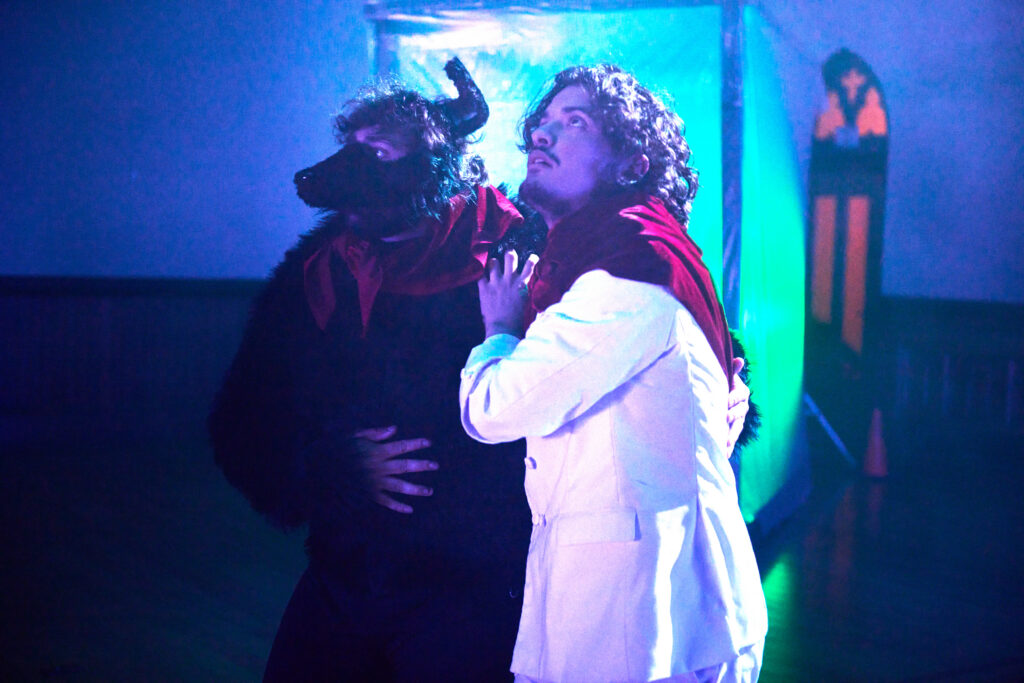
There’s a boy, played with the winsome innocence of a stick figure by Austin Bock, and a dog, played by Marty Alivo in a nightmare-fuel suit of black fur, with a tail that wags convincingly. They accompany Faustus, though he repeatedly entreats them to leave him alone. At length, Faustus reveals that he’s tired of life and wants to go to hell, but can’t, having sold his soul. Mephisto appears, persuades him to perform one evil act, and pretty soon the play is over. It’s not really clear exactly what’s happened to anyone.
That’s probably Stein’s intention. She wrote to a friend: “I have been struggling with this problem of dramatic narrative and in Doctor Faustus Lights the Lights I think I got it.” It’s easy to see the struggle, but not so much how she “got it.” Stein wrote plays like her friend Picasso painted: form is content and vice versa. Stein’s looseness with narrative and denotative language might be part of her purpose, which in many ways foreshadows feminist and postmodern critical theory, with their de-centering of the subject and rejection of grand narratives. Faustus becomes a model for the monological clarity of objective knowledge which, in it’s futile attempt to attain a god’s eye view, becomes alienated from the experience of living. The dual nature of Marguerite Ida & Helena Annabel predates Luce Irigaray’s This Sex Which is Not One by three decades. In place of the tyranny of a techno-scientific grand narrative, Stein offers the open-ended play of words and images.
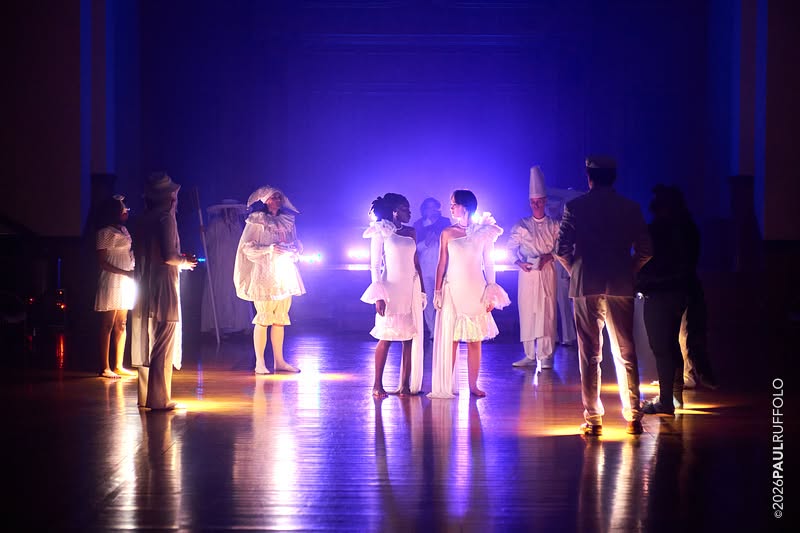
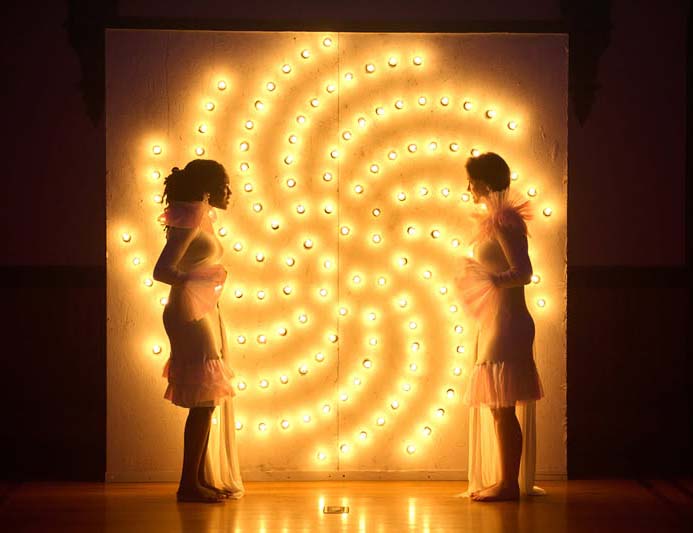
This is heady stuff, but Castine’s staging makes it a visceral experience, even with no clear plot, no psychology, and words that are barely recognizable as sentences. In performance, we can feel it working its spell. Light and sound create palpable atmospheres, as when the ensemble surrounds Faustus carrying lanterns that cast bright light and change colors in an eerie techno-ritual. Illuminated set pieces accent moments in the action, like a human-height spiral of light bulbs that at one point chases into a spinning vortex. The players carry themselves with confidence and a kind of jouissance, as dancers or musicians might have. Music by composer Lincoln Donner spans a spectrum of styles from abstract to pop; at one point, ensemble member Ryan Holifeld sings a surprisingly tender song, accompanying himself on an acoustic guitar. Elements like these bring human warmth to Stein’s imponderable formalisms.
As the evening goes on, you might find your experience mutating: from bafflement to frustration, to curiosity, back to bafflement, to fascination, and perhaps finally surrendering to the overall mood: liberated from solid facts, solid opinions, and solid identities into a kind of giddy free-fall. You might even discover yourself wearing the avant-garde smile.
The local theater scene has become rather sparse and timid since pandemic and inflationary woes ended the most adventurous companies in town. With this daring theatrical long shot, Wisconsin Classic Stage has become a group worth watching; a welcome addition to Milwaukee’s Artistic landscape.
Wisconsin Classic Stage LLC presents
Doctor Faustus Lights the Lights
By Gertrude Stein
Directed, illuminated, and designed by Cole Castine
Original music Composed by Lincoln Donner
Additional music by Ryan Holifield
playing through November 8
https://www.tickettailor.com/events/wisconsinclassicstagellc/2382425